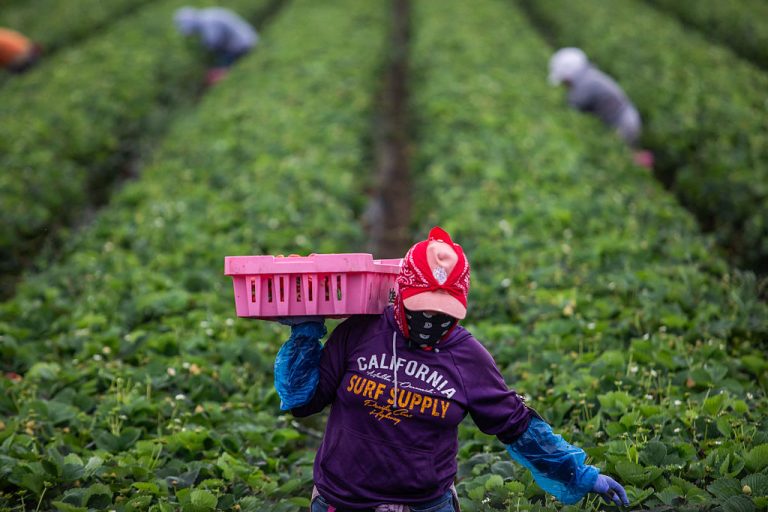
In a recent phone interview with CNBC, President Donald Trump signalled that his administration is considering legal avenues for some migrant farm workers to return to the country amidst his deportation drive, acknowledging their role in sustaining American agriculture.
On CNBC’s “Squawkbox” Trump said, “We’re doing things that are very difficult to do and very complex, but it works really well. We’re sending them back, and then they’re schooling, they’re learning, they’re coming in. They’re coming in legally. We have a lot of that going on, but we’re taking care of our farmers. We can’t let our farmers not have anybody.”
“We’re not going to do anything to hurt the farmers. We’re working on that, and we’re going to be coming out with rules and regulations,” Trump added.
Trump said efforts to recruit domestic labor have largely failed and described immigrant workers as indispensable to farm operations, praising their work ethic saying that they “do it naturally” and are “very special people.”
A White House spokesperson said that the Trump administration is committed to ensuring the country’s farms have the labor they need while also remaining focused on its deportation efforts.
Success
You are now signed up for our newsletter
Success
Check your email to complete sign up
“President Trump is a tireless advocate for American farmers—they keep our families fed and our country prosperous. He trusts farmers and is committed to ensuring they have the workforce needed to remain successful,” spokeswoman Abigail Jackson told The Epoch Times in an emailed statement.
“But there will be no safe harbor for the countless, unvetted, criminal illegal aliens that Joe Biden let waltz into the country. Removing these dangerous criminals and targeting the sanctuary cities that provide them safe harbor is a top priority for the President.”
READ MORE:
- India Hit With Additional 25% American Tariff as Trump Targets Russian Oil Imports
- Insider Report: Zhang Youxia Given Green Light to Direct ‘Special Ops’ in Xi Transition
- NASA Monitoring Asteroid 2025 OT7 as It Approaches Earth
Expanding access to the H-2A program
White House officials are reportedly considering expanding access to the H-2A program for non-seasonal agricultural industries, like dairy, an issue that has been favoured by Republicans in the past.
The H‑2A program, or the Temporary Agricultural Workers Program, allows U.S. farms to hire foreign nationals for seasonal or temporary agricultural jobs when there are not enough domestic workers available.
Trump said that “people that live in the inner city” don’t want to do the work.
“They’ve tried. We’ve tried. Everybody’s tried. They don’t do it. These people do it naturally. Naturally. I said ‘what happens’ — to a farmer the other day — ‘what happens if they get a bad back?’ He said, ‘they don’t get a bad back, sir, because if they get a bad back, they die’ I said, ‘that’s interesting.’ In many ways, they’re very very special people,” the president said.
While an official White House policy has not been tabled, in June the Department of Labor’s new Office of Immigration Policy (OIP) began to coordinate and streamline foreign labor certification programs, including H-2A and H-2B visas.
The H‑2B Temporary Non‑Agricultural Workers Program lets U.S. employers hire foreign nationals for seasonal, peak‑load, intermittent, or one‑time‑need jobs outside of agriculture—such as landscaping, hospitality, seafood processing, or construction—when there aren’t enough U.S. workers. Employers must get temporary labor certification, pay prevailing wages, and the visa is typically valid for up to one year, with limited extensions possible.
READ MORE:
- India Hit With Additional 25% American Tariff as Trump Targets Russian Oil Imports
- US Targets Chinese Goods With Vietnam Trade Deal
A complex situation
According to the U.S. Department of Agriculture, an estimated 40 percent of the country’s farmworkers lack legal status to stay in the country while nonprofit groups such as the Kaiser Family Foundation (KFF), say that number is much higher, at around 47 percent.
The Trump administration has continually said that the country’s deportation drive remains focused on the worst offenders, including gang members and other criminals, while seeking relief for industries reliant on migrant workers such as agriculture and hospitality.
Border czar, Tom Homan, who has been tasked with leading Trump’s deportation policies, told NewsNation in July that his job is to operate within the framework set by the Trump administration.
“So, if the president comes up with a policy, and says, ‘OK, here’s what we’re going to do with farm workers,’ then ICE will abide by that policy,” Homan said.
American farmers and others involved in the industry have warned of supply-chain risks should large numbers of their laborers be deported, especially experienced workers during peak periods.
Zippy Duvall, the president of the American Farm Bureau Federation said in June, “If these workers are not present in fields and barns, there is a risk of supply chain disruptions similar to those experienced during the pandemic.”
According to Reuters, in early July Trump said, “If a farmer is willing to vouch for these people in some way, Kristi, I think we’re going to have to just say that’s going to be good, right?”
“We don’t want to do it where we take all of the workers off the farms,” the president added at the time.