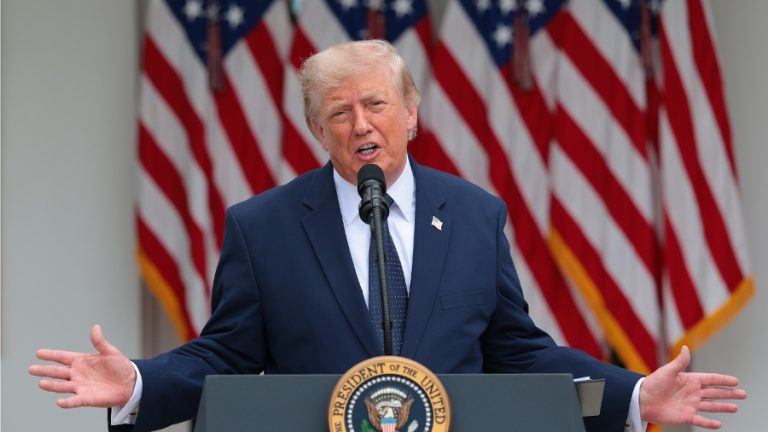
On Monday, Aug. 11, U.S. President Donald Trump signed a last minute executive order extending a tariff truce with China by an additional 90 days, hours before punishing levies were scheduled to go into effect on the communist led country.
The president announced his executive order on his social media platform, Truth Social.
“I have just signed an Executive Order that will extend the Tariff Suspension on China for another 90 days. All other elements of the Agreement will remain the same,” Trump wrote.
Currently, tariffs on Chinese exports stand at 30 percent and, had the deadline passed, the tariff rate would have soared to 145 percent.
By extending the deadline, Trump also avoided 125 percent Chinese tariffs on American goods. Currently China charges a 10 percent tariff on American imports.
Success
You are now signed up for our newsletter
Success
Check your email to complete sign up
The current deal between the two super powers, struck last May, was intended to pause a raging trade war while negotiations progressed.
Earlier on Monday, when asked about the trade negotiations, Trump said that they were going, “quite nicely.”
“We’ll see what happens. They’ve been dealing quite nicely. The relationship is very good with President Xi and myself,” Trump told reporters.
READ MORE:
- Trump May Ease Restrictions, Permitting Certain Migrant Workers to Return to Farms
- Japan’s 2025 Defense White Paper Names China ‘Greatest Strategic Challenge’
- US Targets Chinese Goods With Vietnam Trade Deal
A shaky truce
Last May in Switzerland, American and Chinese lawmakers sat down to discuss trade issues between the two countries. The talks were led by the U.S. Treasury Secretary, Scott Bessent, and U.S. Trade Representative, Jamieson Greer.
Both sides met for a second time in Stockholm, Sweden, in July but failed to ink an agreement on a trade deal.
So far, Trump has secured preliminary trade deals with a number of countries including, the United Kingdom, Vietnam, Japan, Indonesia, the Philippines and the European Union before his Aug. 1 deadline following his “Liberation Day” tariff push.
However, circumstances remain on shaky ground with the world’s second largest economy, China, and the United States’ largest trading partner, Canada, two countries that have so far failed to come to an agreement.
Trump has also said that China’s continued procurement of Russian energy products will be met with secondary tariffs should Beijing continue to buy Russian oil.
Bessent, however, says that he is “optimistic” about a path forward with China, according to reporting by the New York Post.