By Jiantao Paian, Vision Times
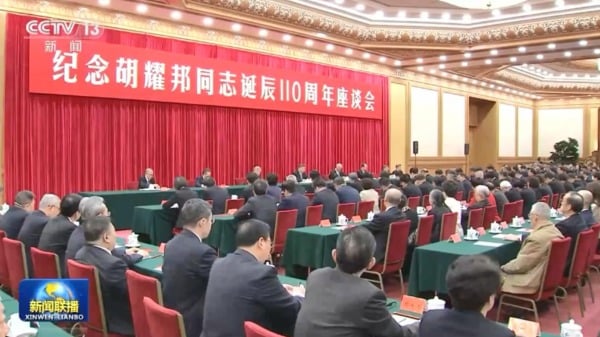
On Nov. 20, Chinese President Xi Jinping held a high-profile symposium commemorating the 110th anniversary of the birth of former Chinese Communist Party (CCP) General Secretary Hu Yaobang. But what drew the most attention among Chinese netizens was not Xi’s speech or attendance; it was the facial expressions of the second generation of “Red elites,” particularly that of Liu Yuan, who appeared to be wearing a PLA Type-95 military uniform in the audience.
Within CCP tradition, each decade brings an official commemoration of Hu Yaobang’s birthday in a ritualistic “rule-keeping” exercise. Xi has now presided over two such meetings, both being highly symbolic. But this time, analysts say the political signals came first from the expressions (and appearances) of this second-generation of “Red aristocrats.”
RELATED: Xi Jinping Loyalist Jing Junhai Resurfaces at Alma Mater in a Sign of Crisis
Red elites and aristocrats refer to the descendants of the Party’s first-generation revolutionary leaders — the sons and daughters of figures like Mao Zedong, Deng Xiaoping, Liu Shaoqi, Ye Jianying, and other founding marshals whose families have long formed an informal but powerful political nobility inside the CCP’s top ranks.
On shaky ground
Success
You are now signed up for our newsletter
Success
Check your email to complete sign up
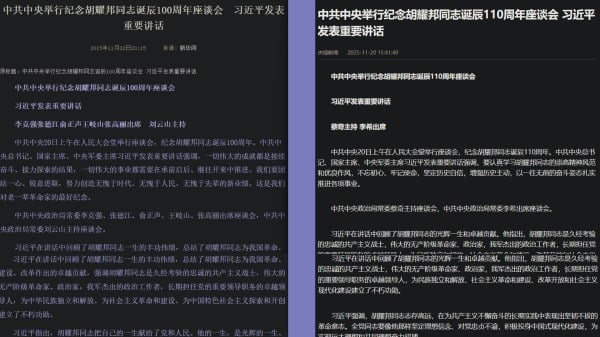
At the 2015 symposium marking Hu’s 100th birthday, Xi delivered an “important speech,” and all seven members of the Politburo Standing Committee (China’s top ruling body) were in attendance. This year, however, only Cai Qi and Li Xi sat with him. Onstage were Shi Taifeng, Li Ganjie, Li Shulei, Li Hongzhong, Chen Wenqing, and Liu Jingguo. Wang Xiaohong and Zhang Shengmin were also said to be present, though Zhang did not appear in the CCTV broadcast — an indication that his Politburo membership may have not been fully formalized.
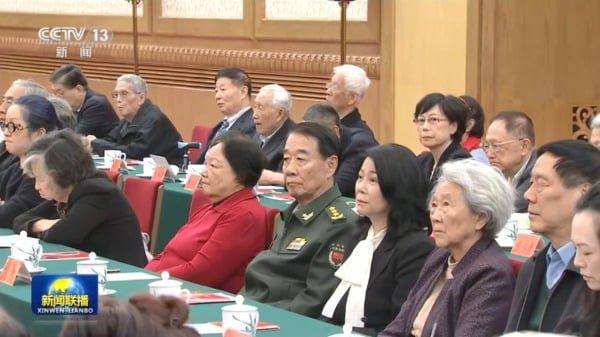
CCTV footage shows what appears to be Liu Yuan seated among Hu Yaobang’s relatives, longtime associates, and representatives from his hometown. If this was indeed Liu Yuan, his appearance in formal PLA dress uniform carries heavy political symbolism, analysts note.
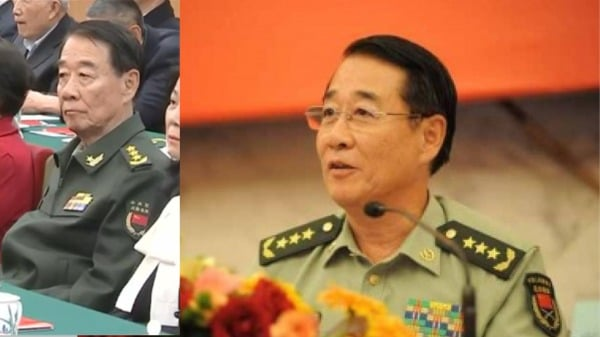
Hu Yaobang had “shown great kindness” to the Liu family, sources say, because he “played a decisive role in reversing the unjust verdict” against Liu Yuan’s father, former state leader Liu Shaoqi. During the event, Liu Yuan appeared solemn, withdrawn, and contemplative — his expression interpreted by some as a restrained form of protest or dissatisfaction. Some online speculation has circulated about Liu Yuan’s political movements, with observers noting that his demeanor at the event might be a deliberate response.
Liu’s expression suggested neither diplomatic courtesy amid current Sino-Japanese tensions nor simple ceremonial attendance. His presence instead triggered speculation about larger political maneuvering, in what Chinese observers deem as playing “grand chess” within the Party.
A lack of enthusiasm
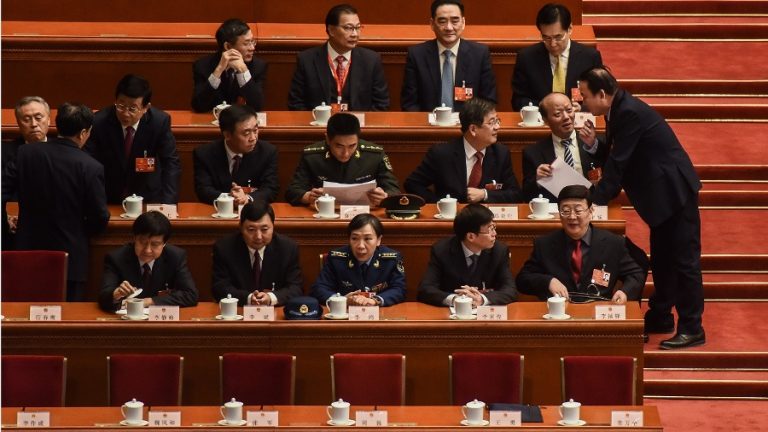
Throughout the row of “Red Second Generation” attendees, few faces showed warmth or support. Their expressions stood in stark contrast to the 2015 symposium, where Xi appeared more confident and the political atmosphere was far more unified. This year, the “background noise” of their stony faces could easily be interpreted as barely concealed disdain toward Xi’s increasingly dictatorial rule.
The symposium placed unusual emphasis on Hu Yaobang’s role in “advocating and advancing reform and opening up.” Analysts say Xi’s messaging aimed to rebut criticism that he has reversed the reformist direction of previous leaders. The argument he sought to project: Xi’s guiding ideology has not deviated from the reform trajectory.
But in reality, Xi has not merely “reversed course.” Rather, he has reinforced and deepened the CCP’s ideological extremism, strengthening the Party’s authoritarian DNA.
This year’s event also emphasized Hu Yaobang’s “unswerving loyalty to the Party,” a phrase delivered in a didactic, almost admonitory tone — seemingly used to justify Xi’s anti-corruption purges and to borrow Hu’s legacy to validate today’s political strictures. The entire symposium revolved around “strict governance of the Party,” offering cadres a standardized template for obeying Xi’s ideological “Eight Articles.” No wonder many attendees looked less than thrilled, experts noted.
Hu Yaobang’s legacy
Hu’s political life has long been assessed and concluded. Though the CCP purged him for known reasons, those reasons are tactically omitted at memorial or other high-profile events. That both pro-reform voices and Party loyalists continue to praise Hu Yaobang reflects deeper truths about his unique place in CCP history.
Within the CCP, Hu Yaobang created the most limited, but genuine, space for liberalization ever permitted under China’s one-party rule system. His policies did not challenge one-party dictatorship, but they pushed the boundaries of what the Party could tolerate. His efforts represented a proto-enlightenment period suggesting an end to authoritarian rule, at least theoretically. He’s also pushed for a transition into a more “pluralistic” political system.
Hu repudiated the Cultural Revolution, corrected the Party’s moral image, and launched a massive reversal of unjust cases — actions that analysts say initiated a reform era that helped rescue the CCP from existential crisis.
Hu’s actions could be viewed through the lens of historical “restoration” periods: the Shaokang Restoration of the Xia dynasty, King Xuan’s Restoration in the Western Zhou, the Guangwu Restoration of the Eastern Han, Emperor Zhao’s restoration in the Western Han, the Yuanhe Restoration of the Tang, and the Tongzhi Restoration of the Qing.
Forging a different path
But unlike traditional dynasties, the CCP is a Leninist party possessed by what the article calls “the ghost of Marxism-Leninism” — authoritarian, atheist, and guided by dialectical materialism as its sole creed. Still, Hu allowed ordinary Chinese to glimpse hope — if only through improved living standards and lifting millions of people out of poverty.
Hu’s push for the principle that “practice is the sole criterion for testing truth,” served as an indirect negation of “communist utopianism.” Like Maslow’s hierarchy of needs, it offered people basic satisfaction while enabling the dictatorship to survive. Within that narrow space, Hu used the highest degree of freedom the Party would permit.
Put simply, Hu Yaobang used visible “Party power” to execute genuinely altruistic policies: limited legal reforms, modest human rights improvements, and greater tolerance for speech so long as it did not directly attack the CCP itself. This created what scholars call China’s “limited political opening,” planting the historical soil that would later give rise to mass public demands, including those culminating in the 1989 Tiananmen student protests.
Hu’s political blueprints, which included “separation of Party and government,” curbing lifelong tenure for officials, and other modernizing proposals, were meaningful contributions to governance inside the CCP. His large-scale rehabilitation of persecuted officials and citizens restored stability for millions of families and temporarily repaired the Party’s moral image. Ironically, these same reforms laid groundwork for the backlash against Xi’s tightening rule decades later.
Hu Yaobang also famously rejected the idea of a dictatorship. He once warned in 1976: “I believe that one day our Party will make a historic resolution: To forever and ever strictly forbid the cult of personality. Once personality cult arises, there is no democracy, no seeking truth from facts, no emancipation of thought — only feudal restoration. Its harm is extremely severe.”
By 1979, Hu took an even sharper stance, “If the people were to learn the true history of the Communist Party, they would rise up and overthrow it.”
A true reformist?
If Hu Yaobang had an ambition for “restoration,” it was the restoration of a reformed CCP—one that he continued to believe could evolve into a legitimate democratic party. His greatest limitation was his unwillingness to challenge the foundational structures of Leninist rule — dubbed the “hammer and sickle beneath the gavel.” He remained bound to the Party’s organizational dogma, making his loyalty a prerequisite for the CCP’s post-humous glorification of him.
RELATED: The Six Words That Reshaped Rural China’s Past
Yet Hu’s contributions offered historical value to both sides: The CCP sees him as a model of “loyal reform,” while dissidents regard him as a rare figure who briefly embodied humanistic governance.
Hu’s greatest achievement was that within a deeply authoritarian system, he did everything he could to advance humanitarian values, intellectual openness, and limited institutional reform. He delivered a brief, fragile period of openness and moral restoration; something Xi Jinping can only long for but is unable to replicate, analysts note.
Editorial note: Views expressed in this article are the opinions of the author and do not necessarily reflect the views of Vision Times.