With tensions escalating between Beijing and Tokyo over the Chinese Communist Party’s objections to Japan’s declaration that it could deploy its military to defend Taiwan, CCP leader Xi Jinping on Nov. 24 made a rare phone call to U.S. President Donald Trump.
The last time a Chinese leader phoned an American president was in 2001, when then-CCP head Jiang Zemin called President George W. Bush to express condolences in the wake of the September 11 terrorist attacks.
While both Washington and Beijing described the call as cordial and focused on bilateral cooperation, the content of the Chinese foreign ministry’s readout and subsequent reporting suggests that Xi’s real priority was Taiwan — and, indirectly, Japan.
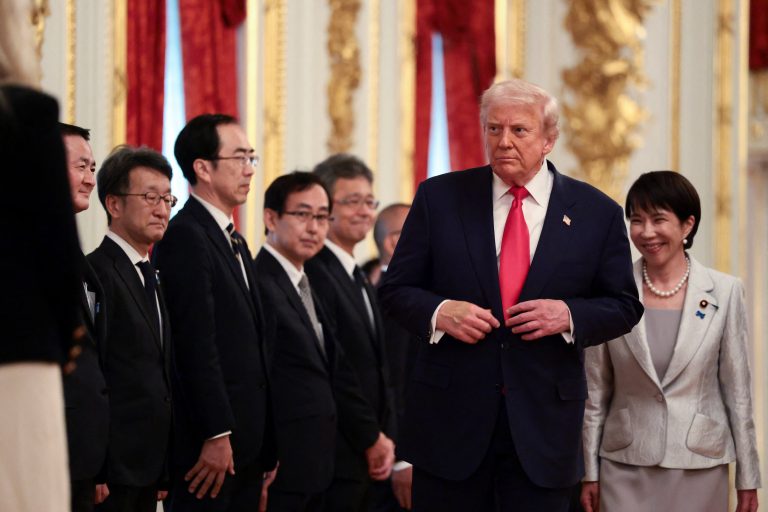
Just hours after speaking with Xi, Trump held a call with Japan’s new prime minister Sanae Takaichi, who has taken a sharply hawkish stance toward Beijing since assuming office. In recent weeks, she has repeatedly emphasized that “a Taiwan contingency is a Japan contingency,” suggesting Japan would consider joining the United States to defend Taiwan against a mainland Chinese attack on the island.
According to the People’s Republic of China (PRC) foreign ministry, Xi began the call by praising his “successful meeting” with Trump in South Korea in October, saying the two leaders had “recalibrated the course of the giant ship of China-U.S. relations” and added “more momentum” for future cooperation. Xi urged the U.S. and China to “keep up the momentum,” continue moving in the “right direction,” and “lengthen the list of cooperation and shorten the list of problems.”

Success
You are now signed up for our newsletter
Success
Check your email to complete sign up
However, the readout indicated that Xi quickly shifted to the topic that has dominated Beijing’s foreign policy messaging in recent weeks: Taiwan. Xi “outlined China’s principled position on the Taiwan question” and stressed that “Taiwan’s return to China is an integral part of the post-war international order.” He further stated that the United States “understands how important the Taiwan question is to China,” implying that Washington should act accordingly.
Trump offered a far more neutral description on Truth Social, calling the exchange “very good” and describing it as a follow-up to their “highly successful meeting” in South Korea. He highlighted discussions on Ukraine, fentanyl, and agricultural issues, saying little about Taiwan. Trump also announced that he had accepted Xi’s invitation to visit Beijing in April 2026 and that Xi would make a state visit to the U.S. later in the year.
Japan’s moves to back Taiwan
According to Takaichi, Trump briefed her on the U.S.–China call and reaffirmed close Japan–U.S. coordination.
She added that Trump told her she was “a very close friend” and that she could contact him “any time,” signaling the durability of security cooperation between Tokyo and Washington even as Trump cultivates warmer ties with China.
Beijing has been sharply critical of Takaichi’s position, which represents the most forward-leaning posture a Japanese leader has taken on Taiwan in decades.
Taiwan, officially known as the Republic of China (ROC), hosts the government that once ruled all of China before retreating from the mainland following the Communist Party’s takeover in 1949. Beijing sees Taiwan as a sovereign part of the PRC, to be “reunified” with the mainland at all costs.

Though Taiwan lost its United Nations membership when a 1971 resolution passed its seat to the PRC, most countries maintain informal relations and embassies with Taipei while adhering to various versions of a “one China policy” that keep ambiguous about Taiwan’s formal status.
Over the past three weeks, PRC state media, diplomats, and ministries have launched a sustained propaganda campaign denouncing Japan’s latest stance, with some even issuing violent threats against the country and its prime minister.
On Nov. 18, PRC ambassador to the United Nations Fu Cong sent a formal letter to the UN secretary-general accusing Japan of “interfering in China’s internal affairs.” On Nov. 20, PRC foreign minister Wang Yi issued a public statement condemning Tokyo’s “dangerous rhetoric.”
While the Chinese foreign ministry’s readout of the Xi–Trump call did not mention Japan directly, Xi’s references to the “post-war international order” and to jointly safeguarding “the victory of WWII” were widely interpreted by analysts as oblique but unmistakable remarks aimed at Tokyo.
Why Xi called Trump
The Wall Street Journal reported on Nov. 24 that Taiwan was Xi’s main focus during the call, citing people familiar with the matter. According to sources “close to Beijing,” Xi sees a “strategic opening” to shape Trump’s thinking on U.S. Taiwan policy ahead of the latter’s planned 2026 visit to China.
The Journal further reported that Xi had deliberately avoided raising Taiwan during his October meeting with Trump in South Korea due to time constraints and the sensitivity of the issue. Instead, he now intends to press Trump directly in Beijing next year to move beyond the traditional U.S. policy of “strategic ambiguity” by formally opposing Taiwan independence and endorsing peaceful unification — positions that would place Washington far closer to Beijing’s line and geographically isolate Taipei.
If accurate, this would be one of the boldest diplomatic objectives Beijing has pursued with any U.S. president in decades.
The foremost ‘red line’ for Beijing
The timing of the call suggests that Japan’s vocal support for Taiwan was likely a major factor behind Xi’s outreach. For Beijing, Taiwan is the foremost “red line,” and Japanese statements framing Taiwan’s security as inseparable from Japan’s national defense pose a strategic challenge.
- Removing Line on Not Supporting ‘Taiwan Independence,’ US State Department Takes Jab at Beijing’s ‘One-China Principle’ (February 2025)
- Beijing Responds After Trump Says Xi Promised Not to Invade Taiwan (August 2025)”
Political risk consultancy SinoInsider wrote in a Nov. 26 newsletter entry that by calling Trump directly, Xi may have been attempting to pressure the U.S. to restrain Japan, particularly regarding explicit security commitments to Taiwan. By framing the Taiwan issue as part of the WWII settlement, Beijing appears to be casting Japan as a violator of the “post-war international order.
At the same time, Xi’s call voices displeasure over Japan’s new rhetoric while demonstrating to the Chinese public that Beijing is taking all possible diplomatic measures.
However, Trump’s omission of Taiwan in his public remarks — combined with Takaichi’s statement emphasizing strong U.S.-Japan ties — suggests that Xi did not receive an immediate concession.
Performative diplomacy
SinoInsider noted in its analysis that Beijing’s recent response to Japan has been “performative but not substantive.” Despite its repeated invective, the PRC has not taken major economic or military countermeasures against Tokyo.
Xi’s dramatic gesture of initiating a call to the U.S. president fits into this pattern by strengthening the narrative inside China that the leadership is defending national sovereignty, portraying Xi as proactive and assertive on Taiwan, and positioning Beijing as a responsible actor “making representations” with all relevant parties and appealing to the “postwar” order.
According to the analysts, Whether the PRC escalates its pressure campaign against Japan in the coming weeks will depend on China’s political needs. Beijing may intend to sustain its “struggle session” against Japan a bit longer before gradually cooling tensions. Alternatively, the Xi–Trump call may have been an attempt to signal an approaching de-escalation.
In either case, the phone call underscores the extent to which Taiwan — as well as Japan’s role in Taiwan’s security — has become the focal point of great-power diplomacy in East Asia.