By Cai Siyun, Vision Times
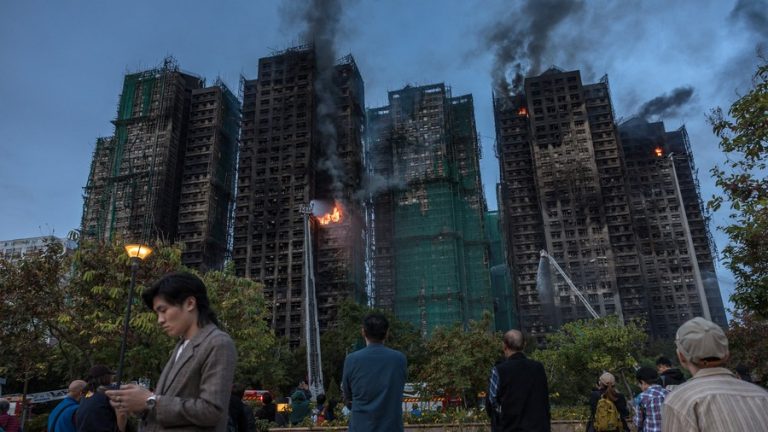
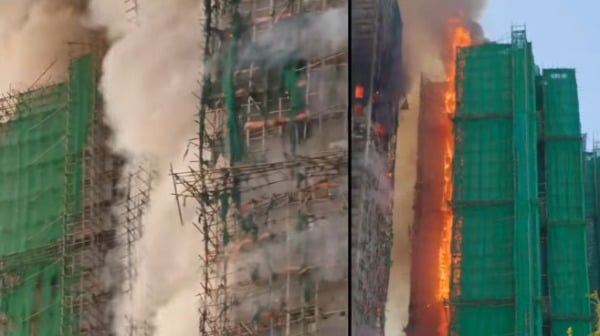
The catastrophic blaze that ripped through Hong Kong’s Hongfu Court last week is now being scrutinized not only as an accident, but as a potential man-made disaster. As the death toll reaches 151, new revelations suggest that the protective netting wrapped around the building’s scaffolding, including material that should have slowed the flames, may instead have acted as fuel. Over 200 people remain missing.
Even more explosive is the identity of the company behind the netting: a Shandong-based firm whose legal representative is named Zhang Shanshan, prompting speculation that she may be the same woman known across China as the “PCR Queen” who profited massively during the COVID-19 mass-testing campaigns.
MORE ON THIS: Hundreds Feared Dead in Massive Hong Kong Tower Fire
A blazing inferno
On the afternoon of Nov. 26, a massive blaze tore through Hongfu Court in Tai Po, New Territories. Seven residential towers rapidly ignited, leaving devastation on a scale rarely seen in Hong Kong. Local engineer investigations quickly shifted attention away from bamboo scaffolding — long used safely in Hong Kong — and onto the protective netting manufactured and certified by entities in mainland China.
Success
You are now signed up for our newsletter
Success
Check your email to complete sign up
Hong Kong construction engineer Pan Zhuohong told Jiemian News that he had noticed problems as early as last year: “Hongfu Court and other major repair projects had scaffold protective nets that did not match fire-retardant standards.” He filed complaints with five separate government departments, including the Fire Services Department, but said he received no meaningful response.
RELATED: Hong Kong’s Worst Fire in Decades Exposes Deep Structural Failure
Under Hong Kong’s APP070 technical code, any scaffolding erected on occupied residential buildings must use flame-retardant protective mesh.
But Pan found that the netting used in Hongfu Court, So Uk Estate, and other projects clearly failed this requirement. He collected samples, ignited them on camera, and documented how easily they burned. He then submitted multiple complaints via Hong Kong’s 1823 hotline and email.
“I went back and forth a hundred, maybe two hundred times,” he said. “None of the relevant authorities took action.”
A Shandong company with zero employees — and a familiar name
Online users uncovered an internal construction notice showing that the protective mesh used at Hongfu Court came from Shandong Chenxu Chemical Fiber Rope Net Co., Ltd., with a quality-inspection certificate issued by the Shandong Binzhou Testing Center.
A deeper online search revealed the company’s registration in Nanzhongli Village, Lizhuang Town, Huimin County, Binzhou City. The firm was founded in 2019 with ¥3 million in registered capital, yet according to official records, it has zero employees. How is this possible?
Its legal representative: Zhang Shanshan. Netizens quickly noted that dozens of rope-net companies are registered in the same tiny village, raising suspicions of shell companies created for bulk certification and paperwork laundering rather than actual production.
Given the history of profiteering during China’s COVID-19 lockdowns, many suspected that this Zhang Shanshan was the same figure behind Nucleus Huaxi Laboratory, whose defective PCR results triggered public scandals in 2022. At the time, online sleuths linked Zhang to 35 different PCR testing companies nationwide.
The company behind many of these labs, Nucleus Gene Technology, was founded by Zhang Heyi, who controls a sprawling network of 79 entities, most carrying variations of the “Huaxi” lab name. While rumors claimed Zhang Shanshan was his daughter, he denied the allegation. Other online posts suggested she was related to the Xi family. None of these claims have been publicly verified.
But the overlap between two explosive industries (PCR testing and construction safety materials) both tied to the same name has intensified public outrage.
‘A corrupt supply chain built for profit, not safety’
Public anger erupted across Chinese social media as netizens accused the companies involved — and the system behind them — of prioritizing profit over human life. Many saw the fire not as an accident, but as the inevitable outcome of a deeply corrupted procurement chain tied to mainland interests.
“Another money-laundering company — buying low, selling high, putting in no capital, and pocketing pure profit,” wrote one netizen. “And it’s dirty profit too, made by selling shoddy goods as if they were premium materials.”
Others argued that the catastrophe ultimately traced back to elite protection:
- “When you trace these disasters to the end, it’s always the red elites cashing in.”
- “Wherever the CCP goes, nothing survives.”
Some users even noted eerie similarities to recent films, claiming the devastation looked almost “scripted”:
- “Andy Lau’s 2024 movie Burning City showed eight Hong Kong towers engulfed in flames — that’s absolutely not a coincidence…”
- “In the film he literally burns down eight buildings. It looks premeditated.”
While speculative, the comments capture a growing belief among Hong Kong and mainland residents alike: Systemic corruption (not spontaneous tragedy) lies at the heart of the blaze, online sleuths note.
Investigators point to lab that certified flammable material
The X-platform account “News Investigation” pushed the discussion further, asserting that the bamboo scaffolding, whic hwas heavily emphasized by state media, was a distraction. “The main cause of the Hong Kong fire wasn’t the bamboo scaffolding,” the account wrote. “It was the protective netting certified by a laboratory in Binzhou, Shandong. What should have been fire-resistant material was certified as such but turned out to be flammable nylon.”
According to the same account, the flame-retardant certification itself came from a mainland testing lab that had replaced Hong Kong’s traditional HOKLAS safety standard — a shift allegedly made for cost-cutting:
“The flame-retardant certification for the scaffolding net was issued by a mainland Binzhou laboratory (CNAS-certified), replacing Hong Kong’s own HOKLAS standard… and the fire-resistant performance was grossly inadequate.”
A follow-up post identified two mainland entities as bearing primary responsibility: the nylon-net manufacturer and the Binzhou inspection center. “By blaming the bamboo scaffolding,” the account concluded, “the CCP is simply dodging responsibility.”
Corruption seeping into Hong Kong’s safety system
To many residents, the scandal fits a broader pattern of “one country, one system,” where Hong Kong’s long-standing safety protocols are increasingly replaced with mainland certifications shaped by political influence, insider networks, and systemic corruption.
As one commenter summarized: “Wherever the CCP goes, it exports corruption and inferior products. This is what ‘one country, one system’ looks like — for Hong Kong, the disasters are only beginning.”
Other users echoed similar frustrations as the official narrative continued to shift blame:
- “That’s the real truth. They kept blaming the bamboo scaffolding, but something felt off.”
- “Bamboo scaffolding has been used safely in Hong Kong for over a century — why would it suddenly fail now?”
- “The Party needs the scaffolding to take the fall.”
- “The Pearl of the Orient, Hong Kong, has already been destroyed by the Communist bandits.”
What should have been a fire-retardant safety measure instead became a fuel source — and the company behind it appears to be a shell entity tied to one of the most controversial names of China’s pandemic era.
Combined with Hong Kong authorities’ failure to act on repeated warnings, the deadly blaze at Hongfu Court serves as a chilling (and devastating) example of how corruption, regulatory decay, and political infiltration can result in real catastrophe.