
By Jin Yan, Vision Times
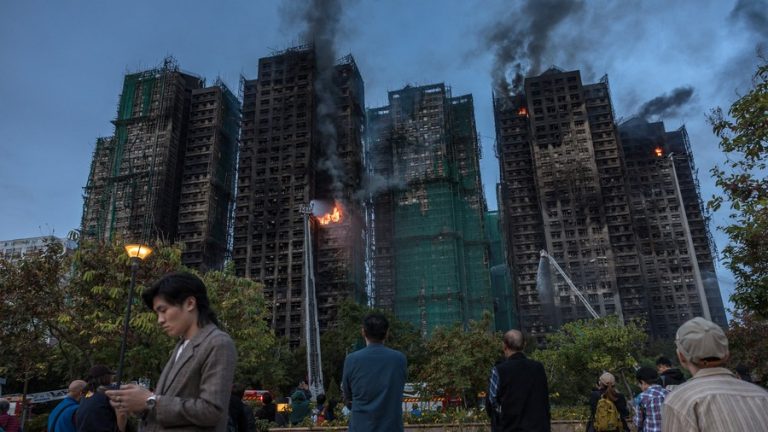
A devastating blaze that ripped through Hong Kong’s Tai Po Hongfuyuan estate in late November — killing 159 people in under four hours and destroying seven residential towers — has become far more than a tragedy. What began as Hong Kong’s deadliest fire in 180 years has now triggered a political storm reaching deep into Beijing, with allegations of rigged construction contracts, defective mainland materials, and links to families at the highest levels of the Chinese Communist Party (CCP).
Veteran journalist Shi Shan and commentator Jiang Feng have both pointed to the same subterranean network of collusion. Jiang goes further, alleging the fire “burned all the way to Zhongnanhai.” He says Hong Kong has been fully “mainlandized,” creating an ecosystem where fake materials, bid-rigging, and political protection flourish unchecked.
RELATED: Hundreds Feared Dead in Massive Hong Kong Tower Fire
The deadly green mesh
“The direct killer of this fire was that green protective net,” said Shi Shan. Flames shot up the exterior of the building in seconds, racing through the nylon netting with unnatural speed. Firefighters said they had “never seen fire spread so fast, so violently.” When fragments of the netting were tested, the results revealed a cheap polyethylene–polypropylene blend with a melting point of just 180°C, producing thick toxic smoke and molten droplets, conditions that likely caused many high-rise residents to suffocate.
Success
You are now signed up for our newsletter
Success
Check your email to complete sign up
The supplier was Beijing Mingli Trading Co., whose legal representative is Peng Lijuan. Jiang Feng alleges she is the younger sister of Peng Liyuan, Xi Jinping’s wife. Even the “certificate of compliance” that accompanied the shipments originated from a U.S. lab partially owned, Jiang claims, by Zhang Shanshan, known in China as the CCP’s “COVID testing queen” and a relative by marriage to Xi.
Jiang summarized the scheme. “The nets cost under 8 RMB per square meter and sold in Hong Kong for 48. The certificate was issued in America, the goods made in Shandong, the money laundered in Hong Kong, and the protection came from Beijing.”
‘Systemic murder’
Hongye Construction won the HK$3.3 billion external renovation contract for Hongfuyuan, beating a compliant bidder that priced the project at HK$1.8 billion. An insider from the owners’ corporation later revealed: “The HK$1.8 billion bidder was eliminated immediately because ‘someone above made a call.’ The extra HK$1.5 billion covered bid-rigging and hush money.”
RELATED: Was Hong Kong’s Inferno Tied to Scandal-Plagued ‘PCR Queen’ Zhang Shanshan?
According to Jiang, once Beijing forced Hong Kong to “mutually recognize” mainland standards after 2019, refusing mainland materials invited accusations of being “unpatriotic” or violating the National Security Law. As a result, regulators stopped testing them altogether — or were forced to declare everything “qualified.”
“This wasn’t corner-cutting,” Jiang said. “This was systemic murder.”
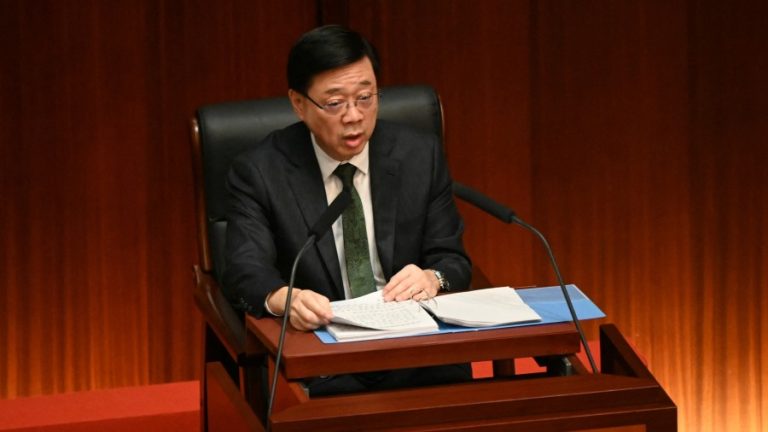
Beijing initially intended to assign blame to Hong Kong — pushing Chief Executive John Lee to resign and elevating Chris Tang — while shielding the elite networks behind the defective materials. But at a December 3 press conference, Lee unexpectedly refused to accept the role of scapegoat. Looking directly at the camera, he declared:
Li Xi’s disappearance
“This incident exposes deep-seated interests. No matter who is involved or how powerful the background, we will investigate to the very end.” Jiang interpreted this as a direct challenge to the CCP leadership: “He was saying, ‘These materials were imported by your princeling families. You dug the HK$7 billion black hole. Why should I take the bullet?’”
Then came an even more dramatic twist. Jiang claims that Li Xi, Secretary of the Central Commission for Discipline Inspection, has not appeared for more than 10 days not because he was detained, but because he defected internally.
According to multiple sources, Li is being protected at the Xishan command compound and working under Vice Chairman Zhang Youxia to interrogate witnesses tied to the Peng family’s operations in Guangdong–Hong Kong–Macau. Key witnesses linked to Ma Xingrui’s faction have reportedly died under suspicious circumstances.
A separate explosive claim describes a secret meeting at Diaoyutai involving Hu Jintao, Wen Jiabao, Li Ruihuan, Zeng Qinghong, and Zhang Youxia. Jiang says they activated “Plan B”: forcibly reshaping the top leadership by removing certain Politburo Standing Committee members. Those allegedly targeted include Cai Qi, Li Qiang, and Ding Xuexiang.
“The fire didn’t just burn Hongfuyuan,” Jiang said. “It burned through Zhongnanhai’s last fig leaf.”
Why all 7 towers burned
Shi Shan noted that eight towers were wrapped simultaneously, though repairs were supposed to proceed in phases. Fire alarms and hydrants in seven buildings failed. Multiple ignition points contradict the government’s “wind-driven blaze” narrative. Hong Kong’s emergency alert system never activated. “This was not an accident,” said Shi. “This shows criminal-level arson suspicion.”
Jiang added that blaming Hong Kong’s scaffolders is a smokescreen to avoid confronting the mainland supply chain behind the defective mesh — a chain that would implicate powerful families and factions.
For Shi Shan, what happened reflects how deeply Hong Kong has been absorbed into mainland governance norms. He said Hong Kong has shifted from “One Country, Two Systems” to what he calls “One Country, 1.1 Systems.” Only the Hong Kong dollar and access to YouTube remain untouched.
Even the government’s language now mirrors CCP political jargon. Terms like “disasters are merciless but humans have love” and “marching ceaselessly” — common in mainland propaganda — appeared in John Lee’s remarks. The word “reform,” rarely used in Hong Kong, sent chills through older generations who recognize it as the vocabulary of political campaigns.
A corrupt construction system
Meanwhile, he warned, Hong Kong now operates dual legal systems: common law for ordinary citizens, national security law for individuals the authorities want to control. A university student who called for “finding the truth and holding the government accountable” was arrested under national security charges.
Shi explained that owners’ corporations for nearly 2,000 units in Hongfuyuan have long been influenced by pro-Beijing parties. Renovation contracts routinely go to favored construction firms, and complaints disappear through opaque channels run by management companies aligned with political organizations. Former legislator Lam Cheuk-ting, who exposed bid-rigging, received a ten-year sentence for “rioting,” while those orchestrating the schemes remain untouched.
“This is the mainland model,” Shi said. “Touch their money, and the National Security Law destroys you.”
Despite the tragedy, Shi emphasized that the Lion Rock Spirit — resilience, mutual aid, and refusing to give up — is not dead. During the fire, volunteers rushed into danger to help residents escape. Long lines formed at blood donation centers. But he warned that Hong Kong’s character is being smothered under mainland-style governance, ersatz materials, and political suppression.
“If Hong Kong can no longer guarantee basic safety, and gives its people 159 charred bodies, and we still remain silent — then we might as well burn the words ‘Lion Rock Spirit’ too.”
He urged Hong Kongers to fight for the city’s remaining institutions by restoring press freedom and judicial independence, breaking political monopolies over owners’ corporations, rejecting unsafe mainland materials and return to trusted international standards, and above all, refuse to surrender their voices.
“Where my heart finds peace, that is my home,” he said. “As long as Hong Kongers exist, Hong Kong has not truly fallen.”
Editorial note: The accounts, allegations, and claims referenced in this report are based on commentary from independent analysts, online sources, and individuals familiar with internal political dynamics. All interpretations should be regarded as analysis or opinion rather than confirmed fact.