By Li Muzi, Vision Times
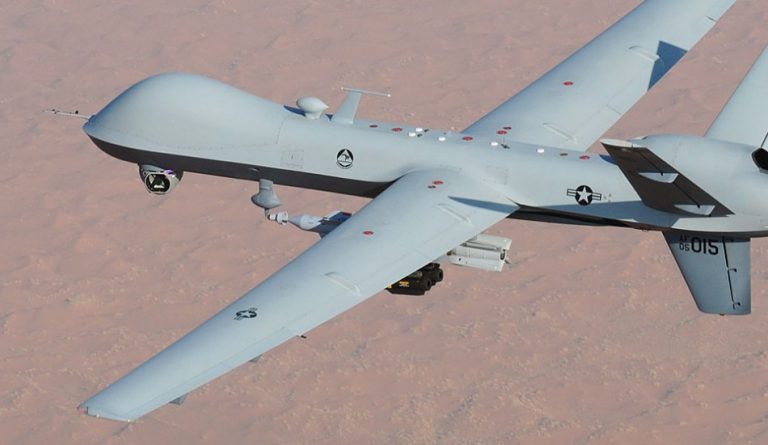
If the Chinese Communist Party (CCP) were to launch a military assault on Taiwan, could Beijing face a targeted drone strike resembling the U.S. operation that killed Iranian General Qassem Soleimani? That question has resurfaced following revelations surrounding the 2026 U.S. National Defense Authorization Act (NDAA), which includes provisions requiring the Pentagon to initiate joint military planning with Taiwan, particularly in the area of unmanned systems and counter-unmanned warfare.
According to reporting by “The Washington Times,” senior U.S. officials have framed the new legislation as a major upgrade in U.S. defense cooperation with Taiwan, aimed at deterring a cross-strait invasion and raising the costs for Beijing should conflict erupt. Veteran national security journalist Bill Gertz, a longtime Washington Times correspondent, wrote on X (formerly known as Twitter) on Dec. 28 that the NDAA mandates planning that could “fundamentally alter” Beijing’s strategic calculus.
RELATED: China Air Force Procurement Investigation Raises Questions Over Senior Officers’ Fate
He wrote that if the CCP launches a military attack on Taiwan, “then a Soleimani-style drone decapitation strike would be replayed in Beijing,” with targets including “every member of the CCP Politburo Standing Committee, including Central Military Commission Chairman Xi Jinping.”
Success
You are now signed up for our newsletter
Success
Check your email to complete sign up
Gertz added, “The Chinese Communist Party would be swept into the ashes of history, just like its Soviet predecessor. This would be the only force on Earth capable of stopping the People’s Liberation Army.”
The Soleimani precedent
The reference point is the U.S. drone strike that killed Qassem Soleimani, commander of Iran’s Quds Force, in Baghdad on Jan. 3, 2020. According to a detailed account published by Middle East Eye titled “Qassem Soleimani’s Final Moments: Tracked, Targeted, and Killed,” Soleimani arrived at Baghdad International Airport aboard a Syrian commercial flight operated by Cham Wings Airlines. Waiting to receive him was Abu Mahdi al-Muhandis, deputy commander of Iraq’s Popular Mobilization Forces, a longtime ally of Soleimani.
The two men had long been on U.S. wanted lists. To evade detection, Soleimani and his entourage did not use smartphones, traveled on commercial flights, dressed plainly, and drove ordinary vehicles rather than armored convoys. From the moment Soleimani stepped onto the tarmac, however, a U.S. drone was already circling overhead, prepared to strike at any moment.
RELATED: Acting Leaders of PLA Eastern Theater Command Appear as April Taiwan Drills Expose Command Vacuum
Two vehicles departed the airport: a Toyota Avalon sedan and a Hyundai Starex van, traveling roughly 100 meters apart. At approximately 1:54 a.m., a missile struck first, destroying the Starex. A second missile narrowly missed the Toyota, grazing past it. As the Toyota accelerated to flee, three additional missiles followed. This time, the vehicle did not escape.
“Soleimani’s remains were ultimately identified by a severed, blood-soaked hand wearing a large, conspicuous red gemstone ring — the same ring he had worn for years,” said Gertz.
At the time, then-U.S. Secretary of Defense Mark Esper said the strike was ordered to protect American lives, not to seek regime change. President Donald Trump stated afterward: “Under my leadership, America’s policy is unequivocal: for those who seek to harm or intend to harm Americans, we will find you; we will eliminate you.”
Esper added in May 2020: “If deterrence fails, and if my commander-in-chief gives the order, we will be prepared to do what the Department of Defense does best—fight decisively and win.”
The ‘Hellscape’ strategy and Taiwan
The 2026 NDAA goes beyond symbolism. Gertz notes that Section 1266 authorizes $9 billion to the Pentagon and explicitly requires the Department of Defense to initiate joint planning with Taiwan, including:
- Deployment of unmanned systems
- Counter-unmanned warfare capabilities
- Joint development and integration of related technologies
“One of the most important Taiwan-related provisions in the 2026 NDAA is the requirement for the Pentagon to launch a joint planning initiative with Taiwan covering unmanned deployment and counter-unmanned systems,” Gertz wrote. The law also states that Taiwan should receive treatment comparable to key U.S. allies such as Japan, South Korea, Australia, and the Philippines, further strengthening Taiwan’s status as a strategic partner.
The Pentagon has already launched an initiative known as “Replicator,” designed to rapidly deploy large numbers of small, low-cost unmanned systems, while simultaneously advancing larger drones, unmanned surface vessels, and unmanned underwater vehicles.
Pentagon Chief Technology Officer Michael Horowitz said earlier this month: “One of the lessons we’ve learned from the Russia-Ukraine war is that the front lines of conflict have already become a contest between humans and machines.” Indo-Pacific Command Chief Admiral Samuel Paparo has described the broader deterrence framework as a “denial strategy,” referring to it as “Hellscape.”
“Machine-to-machine weapons are a key component of this strategy,” Paparo said, adding, “The goal is to deny the CCP the ability to successfully seize Taiwan through military means.” Under this concept, thousands of air and sea drones would form a dense, layered battlefield across the Taiwan Strait, turning the region into what Paparo called a “hellscape” for invading forces.
A warning to Beijing
Under the NDAA, the U.S. Coast Guard will also expand training programs with Taiwan’s Coast Guard, aimed at enhancing law enforcement, maritime security, and deterrence capabilities. Observers note that the combination of unmanned saturation warfare, joint U.S.–Taiwan planning, and explicit legislative backing marks a qualitative shift in Washington’s Taiwan policy.
Gertz concludes that the strategy sends a stark message to Beijing: Any attempt to resolve the Taiwan issue by force would not only face overwhelming military resistance, but could also expose CCP leadership to direct, personalized consequences.
As history has shown, he argues, appeasement does not prevent war; it invites it. Whether Beijing chooses confrontation or restraint may ultimately determine whether the Taiwan Strait remains a flashpoint, or becomes the stage for a conflict that reshapes the Pacific order.
Editorial note: Views expressed in this article are the opinions of the author and do not necessarily reflect the views of Vision Times.