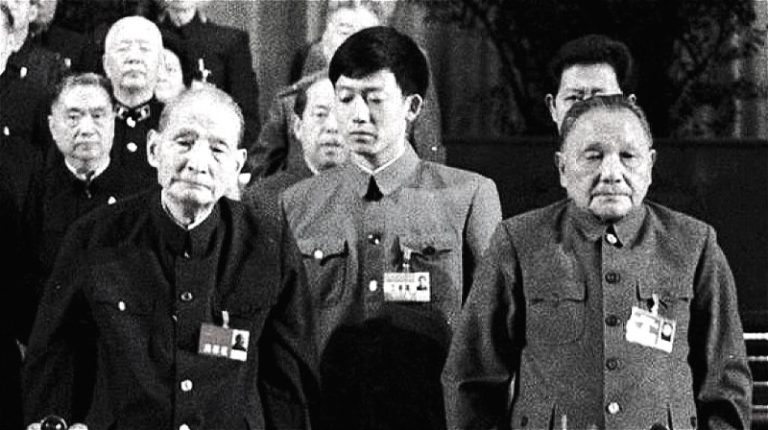
Note: Time rewinds to 1989. The gunfire at Tiananmen Square on June 4 shattered the last illusions in Lois Snow’s heart. Tanks and blood made her realize, in horror, that the political party she and her husband had fervently supported for years had turned its guns on unarmed students and citizens.
This former “old friend” chose no longer to remain silent. She publicly voiced strong condemnation of the Chinese Communist Party’s (CCP) bloody crackdown. Retribution followed: in the early 1990s, when she attempted to visit Peking University to honor her late husband, the university—which once regarded Snow as a benefactor—closed its gates, denying her entry. One can imagine her feelings at the time. Enraged, Lois even appealed to the United Nations, but before the iron curtain of power, all of this seemed feeble and powerless.
She finally understood that the CCP did not want “friends,” but rather “obedient followers” and “propagandists.” When one stops singing praises, the once-red carpet of welcome instantly transforms into cold barbed wire.
The carefully woven ‘Yan’an fairy tale’
Historical perspectives often require a long lens to see the shadows behind the halo. Edgar Snow, the American journalist known worldwide for Red Star Over China, was once the CCP’s most successful card for foreign propaganda. Yet behind him, his widow Lois Wheeler Snow spent her later years trying to cleanse this heavy “friendship,” enacting a story of awakening—from blind trust to awareness, from enjoying privileges to painful repentance, a redemption of the soul.
The story’s beginning lies in a precise calculation by Li Kenong, the king of CCP intelligence: as early as the Yan’an period, the CCP had established an international united front strategy centered on “making friends.” After careful consideration, Li decided the target could not be Soviet (lacking Western credibility) nor an obvious pro-Communist leftist; it had to be a neutral, reputable American hungry for news scoops. Edgar Snow thus became the chosen “prey.”
Success
You are now signed up for our newsletter
Success
Check your email to complete sign up
For this “chance encounter,” Li Kenong personally led a regiment to welcome him. Inside Yan’an, a grand “poverty show” had already been arranged. Snow was lodged in the best cave dwelling available; Li assigned the cleverest and most diligent “Red Little Devils” as attendants. To ensure nothing went wrong, Li personally taught these young soldiers how to make tea, hang clothes, and wipe tables and chairs, making sure every detail made the American journalist feel at home.
The most brilliant psychological tactic lay in contrast. The CCP deliberately let Snow see that Mao Zedong’s own cave dwelling, as the leader, was even more austere than the one prepared for Snow. This carefully crafted display of “integrity” and “sacrifice” deeply struck Snow’s idealistic sentiments.
The effort paid off handsomely. In Snow’s writings, Yan’an became a utopia full of hope. His book not only caused a sensation in the West but also directly influenced U.S. government judgments. Subsequent American inspection teams saw exactly what Snow described, because it had been part of the same meticulously designed layout.
Misled history and America’s cost
Snow’s reporting placed a heavy weight on the scales of history. The Roosevelt administration, sympathetic to the CCP, not only provided vast quantities of arms and equipment but also made strategic misjudgments with deadly consequences.
A frequently overlooked historical detail: on Aug. 25, 1945, just after the end of the war, U.S. planes airlifted core CCP generals — Deng Xiaoping, Lin Biao, Liu Bocheng, Chen Yi, Nie Rongzhen, and others — from Yan’an to the Northeast and North China frontlines. This action occurred even a day before the U.S. airlifted Kuomintang advance forces. The “generosity” of the U.S. government that year effectively paved the way for Chiang Kai-shek’s retreat and the CCP’s seizure of power.
Until retreating to Taiwan in 1949, Chiang bitterly recalled the Bible’s Book of Revelation: “Satan will be released from his prison and deceive the nations.” To him, the red scourge sweeping across China was humanity’s greatest disaster, worsened by the West’s misreading and facilitation.
Red Dynasty VIP: Snow’s ‘imperial treatment’
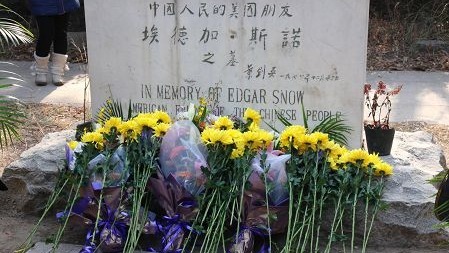
Edgar Snow died in 1972. According to his wishes, part of his ashes was interred by Weiming Lake to symbolize his love for China. His widow Lois inherited this heavy “legacy.”
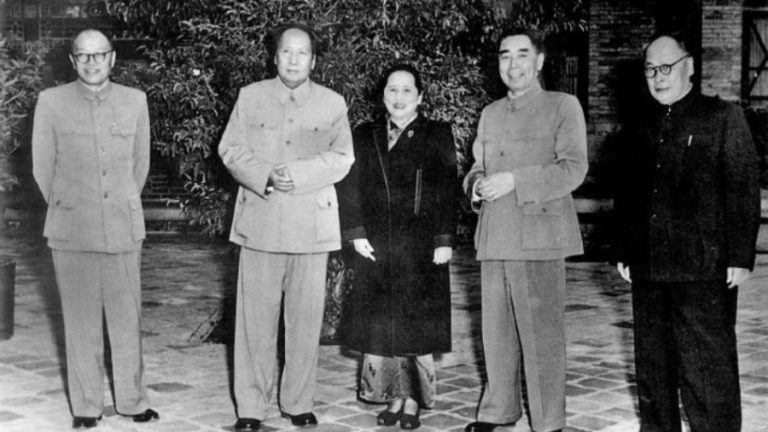
In the 1970s, Lois was Beijing’s most honored guest. She enjoyed imperial-style treatment: traveling in a luxury Hongqi car with lace curtains, watching ping-pong matches with Zhou Enlai, dining with Soong Ching-ling. Her most glorious moment came during National Day parades, standing side by side with her husband on Tiananmen’s rostrum, Mao Zedong beside them—a photo later interpreted as Mao sending a reconciliation signal to Nixon.
Even when Snow fell ill, Mao and Zhou sent a medical team of three doctors and four nurses to Switzerland to care for him. “I was a person of privilege at the time,” Lois admitted in a 2000 Time interview. “I could meet so many people just because I was Edgar Snow’s wife.”
At the time, she basked in the red-hued illusion, unaware of the cost behind such favors.
Late-life repentance: an embrace across the line of control
In 2000, at age 79, Lois Snow returned to Beijing for the last time. This time, she did not come for state banquets; she came to atone.
The trip, dramatically different from thirty years earlier, was tinged with tragedy. Her main purpose was to personally deliver a donation to Professor Ding Zilin, founder of the “Tiananmen Mothers” movement; Ding’s son had died in the 1989 massacre.
When Lois and her son Christopher attempted to enter Renmin University to find Ding, they were met not with flowers and smiles but by a cordon of over twenty plainclothes police. The elderly woman was blocked roughly, secretly filmed, and forbidden from crossing the gate.
Ding later recalled the scene: through the police barrier, Lois angrily asked, “How can you be so cruel? She is an old friend of China!”
On the CCP’s chessboard: no friends, only pieces
The term “old friend” sounded both ironic and heavy at that moment. Lois Snow could not complete her donation, but in standing up to the authoritarian regime in the cold wind, she achieved a redemption of the soul.
The Snow couple’s life was a microcosm of Western leftist intellectuals’ relationship with the CCP: beginning with carefully arranged deception and manipulation, flourishing in blind admiration and praise, and culminating in cruel truths and late-life remorse.
Today, the CCP continues similar united front tactics, only the targets have shifted from Snow to Wall Street financiers, Silicon Valley tech giants, and political and business elites worldwide—the “merchants of the earth” foretold in Revelation.
Yet Lois Snow’s late-life shadow leaves a warning: on the chessboard of authoritarianism, there are no permanent friends, only temporary pieces. When conscience awakens, the myth collapses.
(The article reflects only the author’s personal stance and viewpoint and does not necessarily reflect the views of Vision Times.)