By Yang Tianzi, Vision Times
The Persian Gulf is once again overshadowed by the specter of war as U.S. President Donald Trump warns Iran that a “massive fleet” is moving toward the region, with Tehran responding by stating its armed forces have their “fingers on the trigger.” Behind the escalating rhetoric lies an extraordinary U.S. military buildup in the Middle East, a deepening internal crisis inside Iran marked by violent repression, and a long-stalled confrontation over Iran’s nuclear program.
Analysts warn the next 48 hours could prove decisive in determining whether the standoff moves toward war or negotiations.
RELATED: US War Secretary: Military Prepared to Attack Iran if Trump Orders
A tense standoff
The U.S. currently has roughly 50,000 troops deployed across the Middle East, spread among key strategic locations. About 10,000 personnel are stationed at Al Udeid Air Base in Qatar, the largest U.S. military installation in the region. Additional American forces are positioned in Jordan, Saudi Arabia, Oman, Bahrain, and the United Arab Emirates.
Success
You are now signed up for our newsletter
Success
Check your email to complete sign up
Open-source intelligence analysts report that the U.S. military is conducting its largest regional deployment since the June 2025 “Midnight Hammer” operation. The BBC’s fact-checking unit, using satellite imagery and flight-tracking data, confirmed that at least 15 fighter jets have arrived at Muwaffaq Salti Air Base in Jordan, alongside dozens of cargo aircraft and aerial refueling tankers. Analysts believe these aircraft are transporting additional air-defense systems in preparation for potential Iranian retaliation.
RELATED: Iran Protests Turn Nationwide as Hospitals Collapse
At the center of the buildup is a carrier strike group led by the USS Abraham Lincoln, a Nimitz-class nuclear-powered aircraft carrier originally deployed in the Indo-Pacific. After receiving new orders, the carrier rapidly changed course toward the Persian Gulf. Although the U.S. military has imposed strict operational secrecy, flight-tracking site Flightradar24 detected an Osprey transport aircraft flying from waters near the Gulf to Oman, strongly indicating the carrier’s presence nearby.
A carrier strike group typically fields around 70 aircraft, including advanced F-35 stealth fighters capable of precision strikes. Escorting destroyers and a nuclear-powered submarine carry Tomahawk cruise missiles, giving the group formidable long-range strike capability. As Trump stated bluntly, “We’re sending a massive fleet to the region. Now we’ll see what happens.”
Military analyst Stephen Watkins noted that the types of aircraft observed are particularly significant. RC-135 electronic reconnaissance planes, E-11A battlefield communications nodes, and E-3G early-warning aircraft mirror the configuration seen before last year’s “Midnight Hammer” operation. These platforms are essential for command-and-control and electronic warfare during large-scale air campaigns.
Meanwhile, the U.S. Air Force announced large-scale exercises dubbed “Agile Spartan,” officially framed as rapid-deployment drills but widely viewed as a rehearsal for combat operations. Satellite imagery shows new structures around Al Udeid Air Base, which experts believe are part of newly deployed air-defense systems.
Trump’s dual strategy
Trump has issued direct threats on social media, warning Iran that “the next attack will be even more severe,” explicitly referencing the June 2025 strikes on Iran’s nuclear facilities at Fordow, Natanz, and Isfahan. That operation involved more than 100 aircraft, including B-2 stealth bombers flying directly from the continental United States.
At the same time, Trump has urged Iran to “come to the negotiating table” to reach what he called a “fair and reciprocal deal.” This carrot-and-stick approach reflects his core dilemma: projecting strength while avoiding a prolonged war.
Matthew Savill, military science director at the Royal United Services Institute (RUSI), said Trump is balancing “the desire to appear decisive against the reality of what military force can actually achieve.” While U.S. military superiority is unquestioned, Savill noted that battlefield success does not guarantee political resolution. Trump has repeatedly stated he does not want to be dragged into another long Middle Eastern conflict, suggesting that extreme pressure is intended to force Iranian concessions rather than trigger regime-toppling war.
U.S. Secretary of State Marco Rubio reinforced this view during Senate testimony, saying Iran’s leadership “may be at its weakest point in history,” unable to address mounting protests driven by economic collapse.
Iran crisis at home
Iran is grappling with what analysts describe as its gravest internal crisis since the 1979 Islamic Revolution. Protests sparked by currency devaluation in late December 2025 quickly evolved into a broader challenge to the regime’s legitimacy. The government’s response has been brutally violent.
According to the U.S.-based Human Rights Activists News Agency, more than 6,301 deaths have been confirmed, including 5,925 protesters. Norway-based Iran Human Rights warns the final toll could exceed 25,000. This level of repression has intensified domestic outrage and given Washington additional moral leverage.
Trump has publicly pledged that “help is on the way” for the Iranian people, linking military pressure with support for popular resistance.
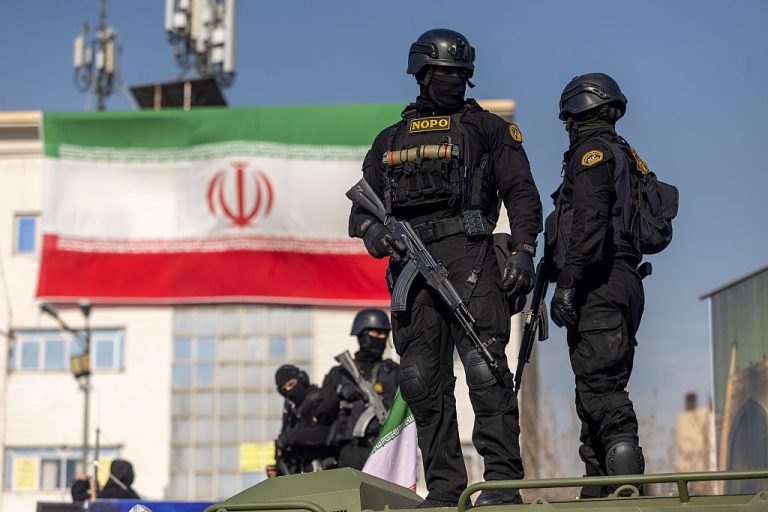
Iran’s official response, however, has been defiant. Foreign Minister Abbas Araghchi said Iran’s armed forces have their “fingers on the trigger” and would respond “immediately and forcefully” to any aggression. Tehran has also unveiled its newest drone carrier, the Shahid Bagheri, in a bid to showcase asymmetric warfare capabilities.
Yet Araghchi simultaneously signaled openness to diplomacy, stating Iran is willing to negotiate “on the basis of equality, without coercion, threats, or intimidation.” He reiterated that Iran’s nuclear program is peaceful and denied any pursuit of nuclear weapons, though Iran’s deputy foreign minister acknowledged that while “messages have been exchanged,” no formal talks with the United States are currently underway.
Nuclear deadlock
The crisis traces back to the collapse of the 2015 Iran nuclear deal, which limited uranium enrichment to 3.67 percent and barred enrichment at Fordow for 15 years in exchange for sanctions relief. Trump withdrew from the agreement in 2018, calling it insufficient to block Iran’s path to nuclear weapons.
Since then, Iran has steadily breached the agreement’s limits, enriching uranium far beyond permitted levels. U.S. officials say any new deal would impose far stricter conditions, including a complete halt to uranium enrichment, limits on Iran’s missile program, and an end to its support for regional proxy groups—demands that strike at the core of Tehran’s security doctrine.
Savill warned that the current U.S. force posture allows Washington to strike “almost anywhere in Iran,” except for the deepest underground facilities. Options range from limited strikes on missile and drone infrastructure to direct attacks on Revolutionary Guard command centers. More extreme scenarios, including leadership “decapitation” strikes, carry far higher risks and uncertain outcomes.
“The question isn’t whether the U.S. can do it,” Savill said, “but what the cumulative effect would be, and how long it would take.”
With massive U.S. forces deployed, internal unrest shaking Iran’s regime, and diplomacy hanging by a thread, analysts say Trump’s warning that “time is running out” reflects a genuine narrowing of options. Whether the coming days bring negotiation or escalation may depend on decisions made in the next critical 48 hours — where miscalculation on either side could trigger a conflict neither claims to want, but both are increasingly prepared to fight.