By Chen Jing
Who is Liu Zhenli?
In a previous article, we examined Zhang Youxia through the perspective of U.S. officials. This analysis turns to Liu Zhenli—a figure sharply distinct from Zhang and from the familiar archetype of “red princelings,” the offspring of revolutionary elites, or bureaucratic climbers shaped in offices rather than on battlefields.
Liu Zhenli joined the People’s Liberation Army (PLA), the armed wing of the Chinese Communist Party (CCP), in 1983 and was assigned to the reconnaissance company of the elite 112th Infantry Division. Reconnaissance soldiers operate at the sharpest edge of the military, tasked with penetrating enemy lines and confronting death directly.
In 1986, Liu was deployed with Lanzhou Military Region forces to the Laoshan front, participating in the brutal Sino-Vietnamese border fighting known as the “Two Mountains rotation.”
For more than a year of positional warfare, Liu served at the most forward positions. Military records indicate that his unit repelled 36 Vietnamese counterattacks under sustained bombardment. As a reconnaissance officer, he not only directed artillery fire but also fought the enemy at close quarters.
Success
You are now signed up for our newsletter
Success
Check your email to complete sign up
Within the PLA, an old saying captures the true cost of battlefield merit: third-class merit requires sweat, second-class merit brings injury, first-class merit costs lives. In peacetime, first-class citations are often awarded for disaster relief. Liu’s first-class merit, however, was earned amid gunfire and bloodshed.
It established his hardest credential within the military: he was not a commander “gilded” in headquarters, but one who led from the front and altered outcomes at the edge of survival.
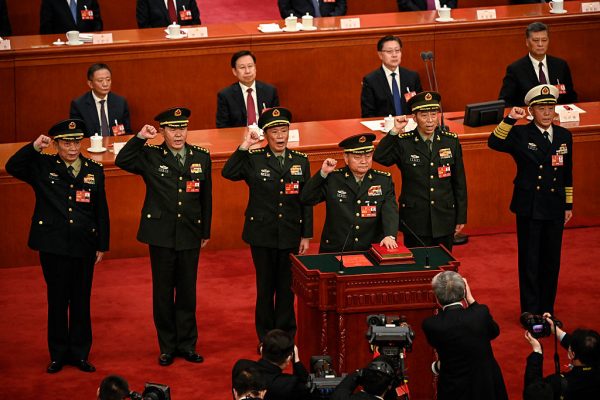
Commander of the ‘ten-thousand-year army’ and a proven crisis leader
Liu Zhenli’s military career is often described as a textbook ascent. Yet it was not built on patronage or factional protection. It rested on professional competence that repeatedly broke age norms within the system.
The most consequential post of his career was command of the former 38th Group Army, known as the “Ten-Thousand-Year Army.” This unit serves as the core force guarding Beijing and has long been regarded as the PLA’s most mechanized and combat-ready formation.
Being entrusted with its command amounted to the strongest possible endorsement of Liu’s operational credibility within the Chinese military hierarchy.
His record extended beyond combat. After the 2015 Tianjin port explosions, when toxic chemicals filled the air and chaos prevailed, Liu—then chief of staff of the People’s Armed Police, China’s paramilitary internal-security force—personally led troops into the core blast zone for rescue operations.
This leadership style, increasingly rare in today’s Chinese officialdom, reinforced his reputation as an officer who absorbed risk rather than delegating it downward.
The PLA’s de facto ‘Chief Operating Officer’
In 2023, Liu Zhenli was appointed chief of the Joint Staff Department of the Central Military Commission (CMC), the CCP’s supreme military decision-making body chaired by Xi Jinping. Outside observers routinely underestimate the weight of this position.
If the CMC is compared to a vast multinational corporation, the chairman functions as board chair, the vice chairmen as deputy chairs, and the Joint Staff chief as the combined chief operating officer and chief strategist.
Zhang Youxia may have wielded greater authority over personnel and enjoyed higher political standing within the Party, but Liu Zhenli held the operational keys to war. He oversaw operational parameters across the PLA, understood weapons-system vulnerabilities, managed intelligence networks, and controlled channels for wartime resource allocation.
All mobilization orders and operational directives ultimately converged on his desk for tactical translation and execution.
His removal therefore signals far more than a routine personnel change. It suggests that the PLA’s operational “brain” has been severed—an assessment consistent with earlier reporting on the systemic consequences of top-level military purges, including “China’s Military Purge Reaches Highest Generals.”
Western defense circles and the loss of the last rational interlocutor
Ironically, Western military leaders appear more unsettled by Liu Zhenli’s downfall than Beijing’s own political apparatus. Within U.S. and European defense circles, Liu was widely regarded as one of the few senior PLA officers who understood modern warfare, reasoned professionally, and could communicate with credibility.
During the 2023 balloon incident, when military communication between China and the United States had nearly frozen, Liu was the official who took the call from the Pentagon. His video conversation with U.S. Joint Chiefs Chairman Charles Brown was not merely symbolic; it was a professional intervention aimed at preventing miscalculation.
This episode stood in stark contrast to the prolonged silence that followed subsequent upheavals within the PLA leadership—a pattern examined in “Zhang Youxia and Liu Zhenli Accused of ‘Splitting the Central Military Commission’ as PLA Remains Silent.”
In April 2024, when Britain’s Chief of the Defence Staff, Admiral Tony Radakin, visited China for the first time in a decade, Liu again served as the named interlocutor.
For Western militaries, Liu represented a remaining interface with Beijing’s armed forces. His disappearance signals a PLA increasingly sealed off from external contact—an opaque black box in which even minor incidents in the Taiwan Strait or South China Sea could escalate without professional mediation.

Zhang Youxia and Liu Zhenli: the last battlefield generation
At the core of their relationship lay shared combat experience. Within today’s Central Military Commission, Zhang Youxia and Liu Zhenli were the only two top-level commanders with genuine battlefield credentials.
Zhang Youxia fought in the 1979 Sino-Vietnamese War and the 1984 Laoshan campaign, earning a reputation as a daring regimental commander. Liu Zhenli entered the same theater in 1986, during the later phase of the border conflict, commanding reconnaissance units at the front.
Their bond was forged not through politics, but under fire. This distinction mattered in a military increasingly dominated by political officers loyal to the Party center—a tension previously explored in “Zhang Youxia’s Strategic Sacrifice Leaves Xi Jinping With No Way Out.”
Complementary roles at the top of the PLA
Their functions within the CMC were complementary by design. Zhang Youxia served as the stabilizing political anchor, managing high-level personnel balance and absorbing pressure from the apex of power under Xi Jinping. Liu Zhenli translated strategy into execution, overseeing troop movements, exercises, and readiness.
Zhang provided political cover; Liu ensured operational coherence. Their relationship resembled that of a veteran chairman and a trusted chief executive—an arrangement that began to unravel as political purges intensified, as documented in “Xi Moves to Smear Zhang Youxia as Troop Movements Point to Internal Conflict.”

Why their downfalls are politically linked
The near-simultaneous downfall of Zhang Youxia and Liu Zhenli follows a clear political logic. Both men possessed battlefield merit and genuine prestige within the ranks. In a system that demands absolute loyalty to the Chinese Communist Party leadership, authority derived from competence rather than patronage represents a latent threat.
Had Liu fallen alone, his removal might have been framed as personal corruption or individual failure. The removal of both, however, points to a deliberate effort to uproot the influence of the combat-experienced cohort—a dynamic consistent with earlier warning signs outlined in “Zhang Youxia Crisis Signals Rare Challenge to Xi’s Authority.”
A dangerous turning point for China’s military
Zhang Youxia’s removal destabilizes internal power balances. Liu Zhenli’s disappearance erodes the PLA’s operational competence and its capacity for internal correction.
When those willing to fight—and those willing to answer the phone—are eliminated, what remains may be blind rigidity and accelerating risk. In an atmosphere of anticipated purges reminiscent of earlier political campaigns, internal factions may resort to desperate countermeasures.
A critical historical inflection point now appears to be unfolding. As the PLA sheds its last layer of professional insulation, the breakdown of military-to-military communication between nuclear powers becomes not merely a diplomatic concern, but a plausible prelude to catastrophe—an outcome foreshadowed in “The Purge of a Top Chinese General Signals a Dangerous Turning Point for Xi Jinping’s Military.”
Editor’s Note: This article draws on publicly available military records, media reporting, and analysis by observers of Chinese military affairs. Assessments of internal power dynamics, command relationships, and operational capability reflect the author’s analysis and cannot be independently verified.