In recent days, the arrests of Zhang Youxia and Liu Zhenli—two senior People’s Liberation Army (PLA) figures widely believed to wield real operational authority—have ignited a political storm. Unusual military movements across China suggest that what Xi Jinping’s leadership has set in motion did not end with the announced downfall of Zhang and Liu. Instead, the struggle between rival forces inside the Chinese Communist Party (CCP) appears to be intensifying.
This is not merely another internal reshuffle or anti-corruption campaign. It is a moment that exposes deep fault lines within the CCP’s military command structure.
History offers a warning. More than three decades ago, a coup attempt that stunned the world hastened the collapse of a totalitarian regime. The military was decisive. Tanks rolled into city streets, and the fate of a ruling party was ultimately determined by soldiers who refused to carry out orders.
Revisiting that moment today reveals unsettling parallels. What is unfolding in China may not be an isolated military purge, but the opening phase of a broader power struggle centered on loyalty, legitimacy, and control of the gun. History, once again, may be repeating itself.
Success
You are now signed up for our newsletter
Success
Check your email to complete sign up
That earlier event was the Aug. 19, 1991 coup attempt, which directly accelerated the collapse of the Soviet Communist Party.
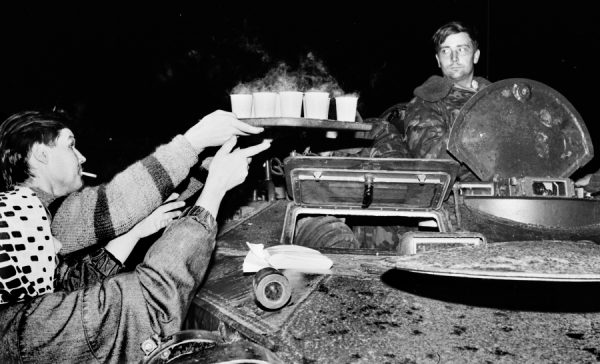
‘Dad, wake up—there’s a coup’
“Dad, wake up! There’s a coup!”
A young girl burst into the room, shouting. Her father, half-awake, muttered a single sentence: “This is illegal.”
Rubbing his eyes, he looked out the window. Armed special-forces soldiers had already sealed off the area.
That father was Boris Yeltsin.
His residence had been surrounded by the Soviet Union’s elite Alpha Group, with checkpoints erected along nearby roads.
After Zhang Youxia and Liu Zhenli were detained, U.S. General Michael Flynn—who spent decades in intelligence work—bluntly described Xi Jinping’s move as “a coup.” The characterization was direct and unambiguous. Yet based on Xi’s record, this coup may still fail. Within the Chinese military, support appears far stronger for Zhang and Liu than for Xi himself.
Xi Jinping has long fixated on the Soviet collapse, repeatedly invoking it as a lesson for the CCP on the dangers of ideological decay and military disloyalty. Ironically, the coup he personally initiated may now be steering China toward the very outcome he fears most—a contemporary replay of Aug. 19. If so, the implications would be existential for CCP rule.
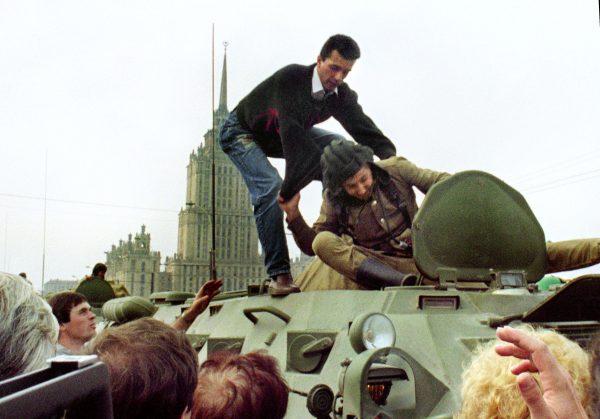
How the August 19 Soviet coup unfolded
On Aug. 18, 1991, Soviet leader Mikhail Gorbachev was vacationing at his favored summer residence in Foros, Crimea. Without warning, his security chief reported that a group of uninvited visitors was demanding to see him.
Sensing danger, Gorbachev replied, “I didn’t invite anyone.”
He reached for the phone to call KGB chief Vladimir Kryuchkov. The line was dead. He tried other phones. Silence. In that moment, he understood that something extraordinary—and dangerous—was underway.
Gorbachev gathered his family. “Anything could happen,” he told them.
His wife, Raisa, later recalled that her thoughts immediately turned to the fate of Tsar Nicholas II and his family after the Bolshevik takeover. She knew precisely what communists were capable of when power was threatened.
Eventually, Gorbachev agreed to meet the visitors. They included the head and deputy head of the KGB’s Ninth Directorate, Defense Council Vice Chairman Oleg Baklanov, Chief of Staff Valery Boldin, Central Committee Secretary Oleg Shenin, and Army General Valentin Varennikov, representing the military.
Varennikov delivered the ultimatum: Gorbachev must either sign a decree declaring a state of emergency or hand power to the vice president.
Gorbachev erupted. He denounced them as adventurists and traitors and warned that they would pay a heavy price.
Then he shouted a line that resonates sharply with China today: “You are pushing the country toward civil war.”
They handed him a list of members of the State Committee on the State of Emergency. Gorbachev was stunned. Defense Minister Dmitry Yazov had been personally promoted by him. Kryuchkov shared the same mentor. Boldin had worked at his side for more than a decade and enjoyed his complete trust. All had turned against him.
After departing, the head of the KGB’s Ninth Directorate ordered Gorbachev’s further isolation by radio. On their drive back to Moscow, the plotters began drinking.
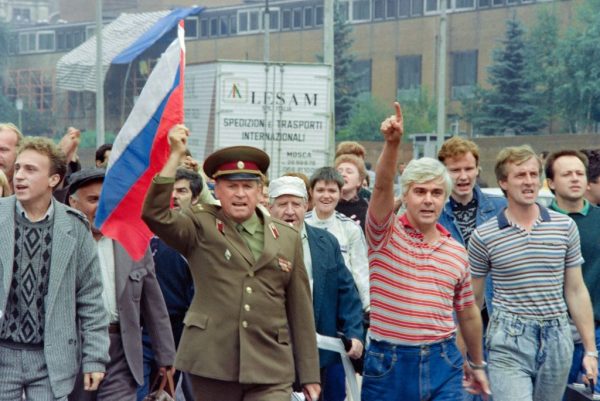
Tanks enter Moscow
Back in Moscow, the coup moved into the open. Claiming that Gorbachev was gravely ill, Vice President Gennady Yanayev announced that he had assumed power. His hands visibly shaking, he signed the emergency decree. Defense Minister Yazov, Kryuchkov, Prime Minister Valentin Pavlov, Interior Minister Boris Pugo, and Baklanov followed, one after another.
In CCP terms, these men were equivalent to a state vice president, a premier, a vice chair of the Central Military Commission—the party body that commands the PLA—and the heads of state security, national defense, and internal security. None would meet a good end.
At 4:00 a.m. on Aug. 19, the meeting adjourned. Thirty minutes later, Yazov ordered all military units to full combat readiness. Leave was canceled. Troops were recalled. By around 6:00 a.m., elite units were advancing toward Moscow’s ring road, preparing to occupy the capital.
As armored vehicles and tanks roared through the streets, citizens watched in fear.
Elderly women clutched their chests and whispered, “Has the war started?”
Young people were blunt: “It’s a military coup.”
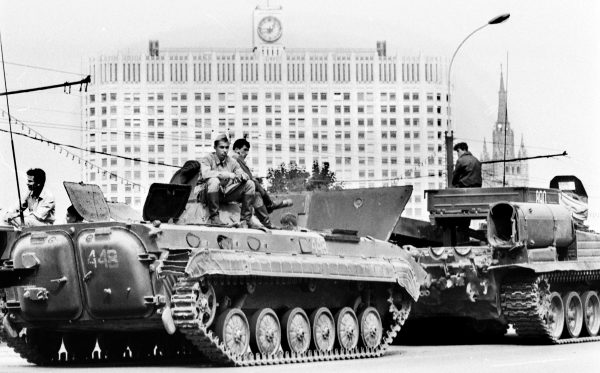
Thousands rally to defend the ‘White House’
A decision was made to surround Yeltsin’s residence, but the KGB leadership hesitated to arrest him immediately. That single moment of hesitation proved decisive.
Yeltsin put on a bulletproof vest, pulled on his shirt and suit, and headed for the “White House”—the Russian parliament building. Alpha Group followed, occupying key positions. A list of 70 people had already been prepared for arrest.
Inside the White House, Yeltsin urgently drafted an “Appeal to the Citizens of Russia.”
Crowds gathered rapidly. Barricades went up. Weapons were sought. A direct confrontation loomed.
Yeltsin issued Decree No. 59, declaring all decisions of the so-called State Committee on the State of Emergency illegal and void within Russia. Standing atop a tank, he read the decree aloud.
The military began to waver. Air Force commander Yevgeny Shaposhnikov refused to use force against civilians. Naval commanders followed suit. A battalion of the Ryazan Airborne Division defected to defend the White House.
Inside the coup leadership, panic spread. Yanayev unraveled. Pavlov collapsed and was hospitalized. Yazov delayed, hesitated, and lost control.
At a televised press conference, journalists bluntly asked whether this was a coup. Across the country, viewers saw trembling hands, flushed faces, and incoherent answers. The spectacle destroyed what little authority the plotters still possessed.
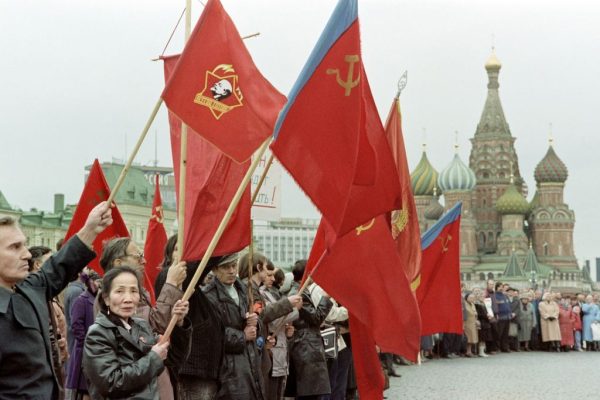
When the military refuses to shoot
Orders were issued to storm the White House. No one was willing to carry them out.
The Alpha Group commander refused outright. “We will not storm the White House,” he declared. “We won’t bleed for idiots like Kryuchkov and Yazov.”
Air force and airborne commanders went further, warning that if the White House were attacked, bombers would fly over the Kremlin.
Yazov recoiled. “I won’t be Pinochet,” he said.
By the third night, Kryuchkov called the White House. “It’s over,” he admitted.

A coup that destroyed its own system
On Aug. 22, Gorbachev returned to Moscow. The coup leaders were arrested. On Aug. 23, Yeltsin ordered the suspension of the Russian Communist Party. Within days, the party was declared illegal in Russia.
The architects of the coup never imagined that their bid to seize power would instead accelerate the collapse of the entire system.
Xi Jinping has presided over countless unfinished projects. What may now be unfolding is the most consequential unfinished project of all—one personally planned and executed, and potentially fatal to CCP rule itself.
Editorial note: Views expressed in this article are the opinions of the author and do not necessarily reflect the views of Vision Times.