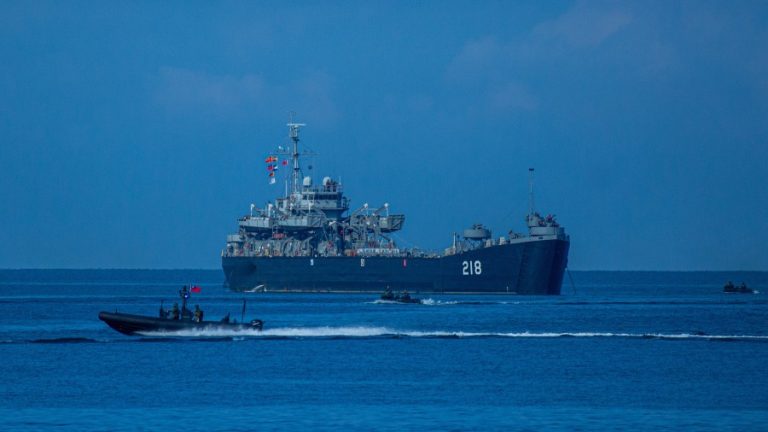

The U.S.-Philippines Strategic Dialogue was held on Tuesday, Feb. 17. The U.S. State Department issued a joint statement emphasizing that collective defense is crucial for deterring aggression anywhere along the First Island Chain. Both sides condemned China’s coercive actions in the South China Sea and reaffirmed the importance of maintaining peace and stability across the Taiwan Strait.
The 12th U.S.-Philippines Bilateral Strategic Dialogue took place in Manila, the capital of the Philippines, with senior officials from both countries participating. The State Department released a joint statement in the afternoon, focusing on strengthening the alliance to restore deterrence in the Indo-Pacific, and also covering U.S. initiatives on energy and supply chain security.
According to the statement, both sides pledged to maintain high vigilance in the Indo-Pacific to prevent conflicts, and to implement robust measures and deterrence mechanisms to ensure maritime routes remain open and not under arbitrary control by any country. Collective defense is critical for preventing and deterring aggression anywhere along the First Island Chain.
Both sides also reaffirmed their commitment to the Mutual Defense Treaty (MDT). Signed in 1951, the U.S.-Philippines Mutual Defense Treaty commits both parties to act jointly if either’s homeland or territories, forces, public vessels, or aircraft in the Pacific are attacked by force.
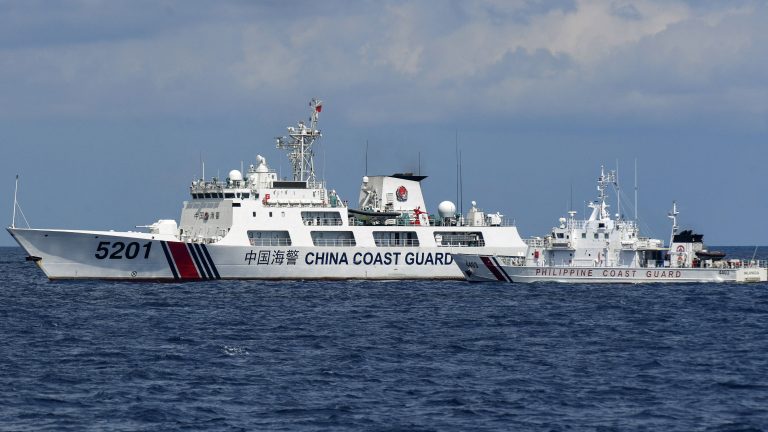
The U.S. and the Philippines condemned China’s illegal, coercive, aggressive, and deceptive actions in the South China Sea, stating that such behavior undermines regional peace, stability, and the economies of the Indo-Pacific and broader regions.
Success
You are now signed up for our newsletter
Success
Check your email to complete sign up
The two countries highlighted the importance of maintaining peace and stability across the Taiwan Strait and strongly opposed any threats or use of force to violate another country’s territorial integrity or political independence. They committed to safeguarding a free, secure, prosperous, and stable Indo-Pacific.
Looking ahead for this year, the statement noted that the U.S. and the Philippines will strengthen joint operational capabilities and conduct more realistic exercises to enhance readiness for emergencies. The U.S. will promote the modernization of the Philippine military and coast guard, and increase deployment of advanced U.S. missiles and unmanned systems to the Philippines.
According to the statement, the U.S. Department of Defense will allocate an additional $144 million for Fiscal Year 2026 to support U.S.-Philippine Enhanced Defense Cooperation Agreement (EDCA) sites and committed to advancing infrastructure development at these sites through bilateral cooperation.
EDCA allows the U.S. to use Philippine bases for joint training, equipment storage, and the construction of runways, fuel depots, and U.S. military housing, but does not establish a permanent U.S. presence.
The two countries will also strengthen civil nuclear cooperation, including U.S. experts assisting the Philippines in developing nuclear education courses and certification systems to cultivate local talent capable of constructing and operating advanced nuclear reactors.
The U.S. will provide $1.5 million to establish a small reactor control room simulator in the Philippines, ensuring regional nuclear development meets the highest safety and non-proliferation standards.
The statement also noted that the U.S. and the Philippines will expand bilateral cooperation to build secure and standards-compliant critical mineral supply chains.
The U.S.-Philippines Bilateral Strategic Dialogue was first held in 2011 and serves as a platform for discussing political, security, and economic cooperation. It allows both sides to exchange views on current challenges and strategic priorities and establish new initiatives for collaboration.