The CCP has dramatically expanded its purchases of Iranian crude. China is now Iran’s only significant oil customer. Nearly all of Iran’s oil production flows to China. A decade ago, that share was roughly 30 percent.
The Wall Street Journal reported on April 7 that this shift has allowed Iran to keep generating massive revenue despite long-standing U.S. sanctions. The money keeps the regime running and funds its war effort.
During Donald Trump’s first presidential term, the United States launched a “maximum pressure” campaign aimed at cutting off the regime’s main revenue stream, its oil exports. Iran still ships billions of dollars’ worth of crude every month, almost entirely to Chinese buyers.
Beijing and Tehran have built an elaborate trading network to get around American sanctions. U.S. officials and researchers call it one of the largest sanctions-evasion systems in existence.
Payments are routed through small Chinese banks with minimal international exposure. If these banks are sanctioned, the damage to their operations is limited. Iran also manages money flows through shell companies registered in places like Hong Kong.
Success
You are now signed up for our newsletter
Success
Check your email to complete sign up
China’s state-owned energy giants gradually pulled back from Iranian crude to avoid American sanctions. Their place was taken by China’s private “teapot” refineries, small independent processors now buying most of Iran’s crude. These firms use forged invoices and falsified origin labels to conceal where the oil comes from.
Through this system, Iran earns tens of billions of dollars annually from China, according to U.S. sanctions documents, public indictments, and accounts from Western officials and researchers. The money is laundered and spent worldwide.

The CCP is Iran’s ‘primary partner’ in sanctions evasion
Max Meizlish, an expert at the Foundation for Defense of Democracies, a Washington think tank, said the CCP is Iran’s “primary partner” in sanctions evasion. Without Beijing’s sustained support, Iran would struggle to maintain its current position.
The Journal reported that Beijing buys Iranian crude for two reasons: China needs the energy, and sanctions push Iranian prices to steep discounts that make the deal hard to pass up.
Washington has tried to crack down by expanding sanctions and indicting individuals involved in the China-Iran oil trade. But the U.S. has held back from more aggressive enforcement, wary of driving up global oil prices and damaging the U.S.-China relationship.
China and Iran have assembled a “shadow fleet” of oil tankers. These ships switch off their tracking systems and change names frequently. They also conduct ship-to-ship transfers at sea to disguise where the oil comes from.
C4ADS, a U.S.-based nonprofit that tracks illicit networks, reported that a CCP-centered shipping network has transported more than 400 million barrels of sanctioned Iranian oil.
Chinese banks have become central to Iran’s sanctions-evasion financing. Kunlun Bank was sanctioned by the United States as early as 2012 for facilitating transactions with Iran. The sanctions backfired. Kunlun became a dedicated platform for settling China-Iran deals in Chinese yuan, since it had nothing left to lose in the Western financial system.
Some transactions bypass the banking system entirely. Chinese firms build infrastructure for Iran in exchange for oil, a barter arrangement. In 2024 alone, deals structured this way totaled roughly $8.4 billion, according to the Journal.
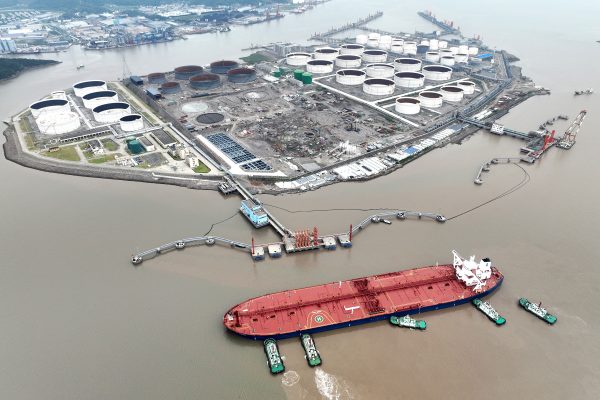
China stopped publishing Iran oil import data in 2023
The CCP stopped disclosing how much oil it imports from Iran beginning in 2023. Kpler, a commodities research firm that tracks tanker movements worldwide, estimates that China still imported approximately 1.4 million barrels per day from Iran in 2025. That volume accounts for more than 80 percent of Iran’s total crude exports.
This trade continues even as the current Middle East conflict intensifies. Tankers loaded with Iranian crude keep sailing toward Chinese ports, even as Iran restricts Western vessels passing through the Strait of Hormuz.
Russia has also been quietly supporting Iran’s war effort. The Financial Times reported in March 2026, citing Western intelligence sources, that Moscow is preparing to ship drones, medicine, and food to Tehran. The sources described this as the first evidence since the war began that Russia is willing to provide “lethal weapons support” to Iran.