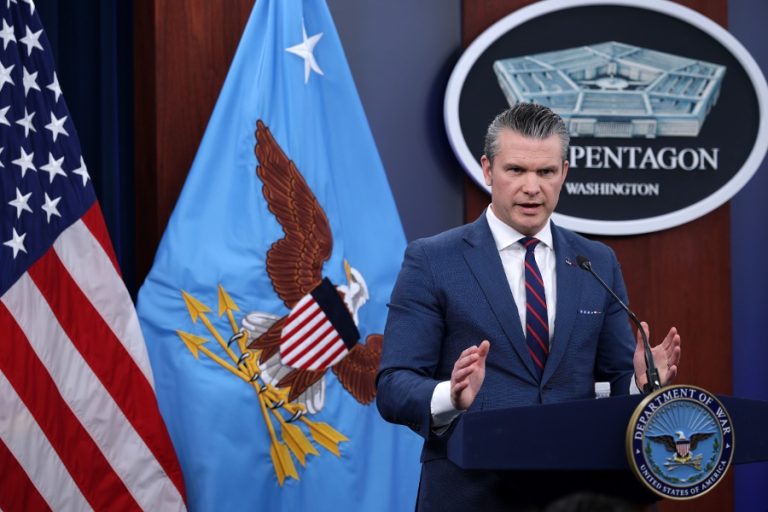
U.S. Secretary of Defense Pete Hegseth and Chairman of the Joint Chiefs of Staff Gen. Dan Caine jointly held a press conference on Friday, April 24 to provide an update on Operation Epic Fury.
Hegseth announced that the U.S. military blockade of Iran is tightening at an “astonishing pace” and expanding globally, with a second aircraft carrier set to join the blockade within days. Gen. Caine detailed recent combat operations in which U.S. naval forces used ship-mounted artillery to disable vessels violating the blockade and seize cargo ships attempting to break through.
During the briefing, Hegseth issued a final ultimatum to Tehran, stating that Iran currently has a “historic opportunity” to reach a serious agreement, the core requirement being the complete and verifiable abandonment of its nuclear weapons program.
Hegseth emphasized that no vessel may enter or leave the Strait of Hormuz without authorization from the U.S. Navy, and that the blockade will remain in effect until President Trump makes a final decision. He warned that if Iran fails to make the right choice, it will be forced to watch its fragile economy collapse under the full-spectrum maximum pressure of the U.S. military.
RELATED:
- US-Iran Maritime Standoff Escalates As Strait Of Hormuz Tensions Surge
- US Blockade of the Strait of Hormuz Cuts Iran Oil Flow, Raises Pressure on China’s Energy Supply
At present, the USS Lincoln and USS Ford carrier strike groups are already deployed in the region, while the USS Bush is moving closer to Iranian waters. Hegseth stated that U.S. forces are fully prepared for “whatever comes next.”
Success
You are now signed up for our newsletter
Success
Check your email to complete sign up
Regarding enforcement actions, Gen. Caine provided details on the U.S. seizure last Sunday (April 19) of the Iranian cargo ship M/V Touska. According to Caine, the vessel was the only ship since the blockade began that attempted to forcibly breach the blockade line.
After a six-hour interception and multiple ignored warnings, a U.S. Navy destroyer used its Mk 45 five-inch naval gun to fire five inert precision rounds into the ship’s engine room, after ensuring crew members had evacuated. Once the vessel’s propulsion system was physically disabled, U.S. Marines boarded via helicopter and took control.

As of Friday, the total number of Iranian-linked vessels intercepted or forced to turn back by U.S. forces had risen to 34.
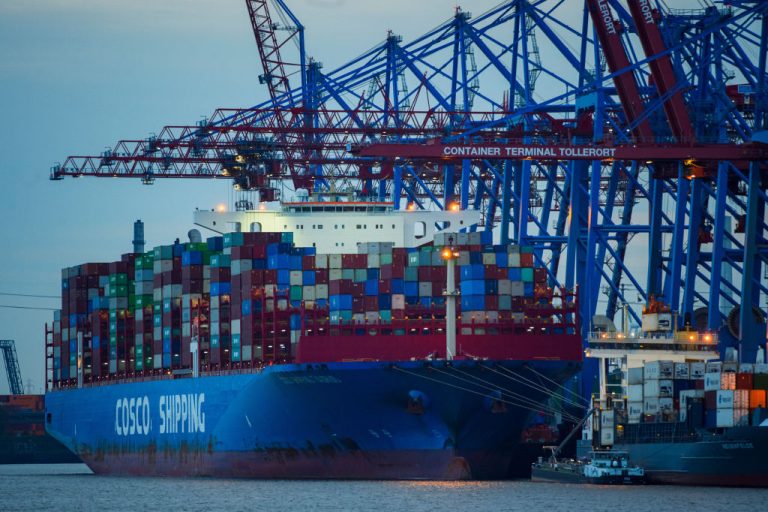
The blockade has now expanded into the Indo-Pacific and Indian Ocean regions. U.S. military officials confirmed that this week, American forces intercepted and seized two “shadow fleet” vessels in the Indian Ocean attempting to evade sanctions:
- The M/T Tifani, a supertanker carrying 2 million barrels of oil
- The stateless tanker M/T Majestic X, which was en route to Zhoushan, Zhejiang, China
Hegseth stated that these ships believed departing port early would allow them to escape detection, but the U.S. global surveillance network had effectively locked them in. He declared:
“Our blockade is going global. Sanctions evasion will have nowhere to hide.”
On international relations, Hegseth delivered an unprecedentedly tough message to U.S. allies in Europe and Asia. He said the era of allies “free-riding” under U.S. protection for decades is over, and that alliances must now be genuinely reciprocal.
Hegseth criticized European nations for “talking more than acting” during the Strait of Hormuz crisis, accusing them of preferring meetings over meaningful operational support. He stressed that maintaining open access through the Strait of Hormuz is far more critical to Europe than to the United States, and that allies must demonstrate real capability and loyalty through action.