In recent years, the Chinese Communist Party’s rhetoric toward Taiwan has continuously evolved—from the “1992 Consensus” to “shared national identity,” and from “peaceful exchanges” to “benefiting Taiwan through economic incentives.” To the outside world, this may appear as a gesture of goodwill, but in reality it consistently revolves around a core objective: wrapping political goals in united-front messaging, alternating incentives and pressure.
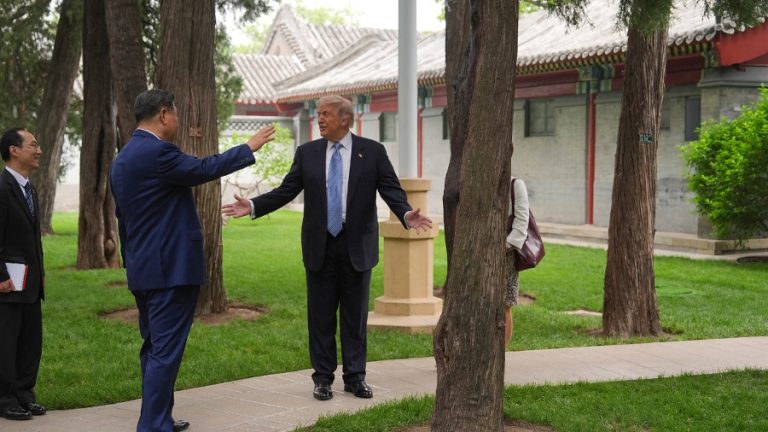
The recent so-called “Zheng–Xi meeting” and interactions between the CCP and the Kuomintang follow a similar pattern: first blurring the distinction between two governments and two political parties across the Taiwan Strait, then using economic tools and narrative framing to create an illusion of “peace,” leading outsiders to mistakenly believe there is a shared foundation. However, whether it is “the Chinese nation” or the “1992 Consensus,” there has in fact never been a truly unified position between the two parties or between the two sides of the strait.
For this reason, what appears to be a polite meeting instead becomes a mirror reflecting the true nature of the CCP’s united front strategy. The underlying reality is the CCP’s long-standing tactic of combining “incentives and punishment.”

The ‘Zheng–Xi meeting’ exposes the divisions
The two most frequently mentioned terms in this meeting are “the Chinese nation” and the “1992 Consensus.” However, these two terms precisely reveal the core problem.
The so-called “Chinese nation” cannot be automatically equated with the Chinese Communist regime. Since its founding, the Chinese Communist Party has followed Marxism–Leninism. Its political nature, ideology, and traditional Chinese culture are not fully compatible. The Republic of China is the entity that continues China’s historical and cultural legacy, whereas the CCP is a political system rooted in revolution and class struggle. Portraying the CCP as the representative of the Chinese nation is itself a conceptual distortion.
Success
You are now signed up for our newsletter
Success
Check your email to complete sign up
As for the “1992 Consensus,” the issue is even more complicated. The 1992 Hong Kong talks between Taiwan’s Straits Exchange Foundation and China’s Association for Relations Across the Taiwan Strait did not produce any jointly signed formal document. The term “1992 Consensus” was later coined as a political shorthand. It was not until 2000 that Taiwan’s Mainland Affairs Council chairman Su Chi, before leaving office, first formally used the term, defining it as “one China, with respective interpretations.” This interpretation was also rejected by the CCP.
Both sides have long held different understandings: Taiwan tends toward “one China, respective interpretations,” while the CCP insists on the “one China principle.” Since there has never been a shared definition, it is difficult to argue that such a “consensus” truly exists.
More importantly, even if some form of “1992 Consensus” did exist, whose consensus would it be? If it is a political consensus at the government-to-government level, then having an opposition party leader meet with the CCP leadership already raises an issue of role mismatch. If it is merely an exchange between two civil organizations, then it should not be framed as political mutual recognition.
In this meeting, even an updated version of the undefined “1992 Consensus” appeared—namely “the 1992 Consensus, opposing Taiwan independence”—which clearly deviates from the original intent of the 1992 Hong Kong talks and subsequent correspondence. This is where the core problem lies: the CCP consistently repackages ambiguous concepts as political bargaining chips and then demands the other side accept those chips as legitimate.
Live broadcast cut off: the CCP does not believe in equality
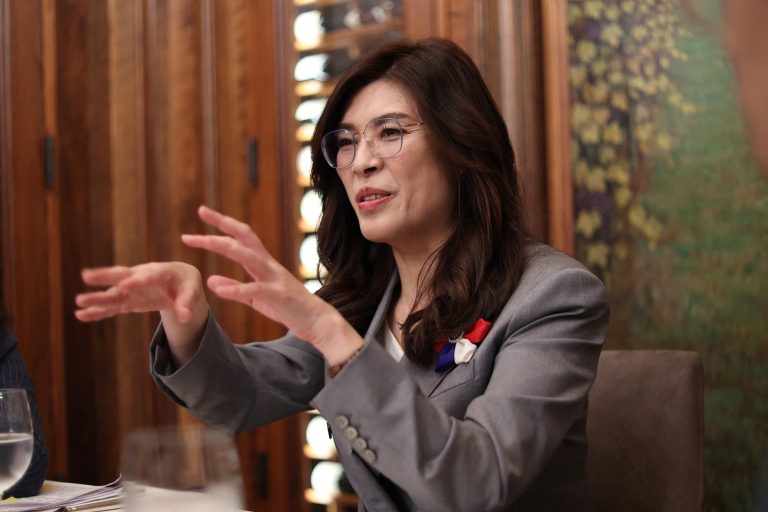
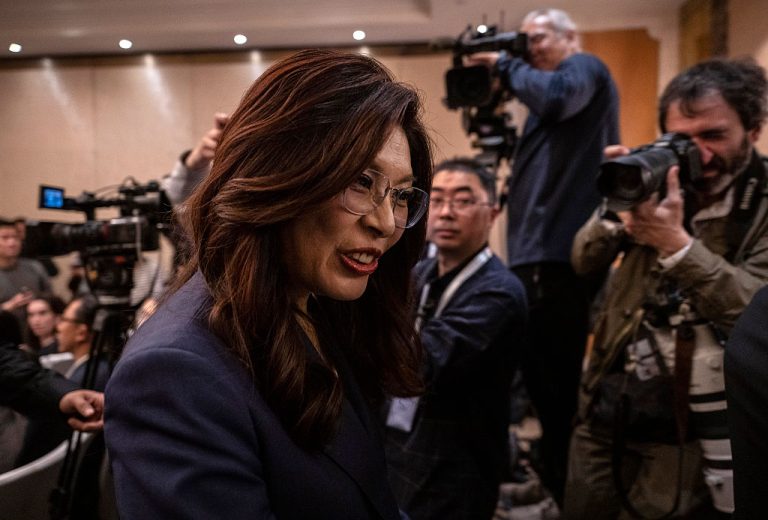
Another notable detail from this meeting is that during Cheng Li-wen’s speech, the live broadcast was suddenly cut off and reporters were asked to leave the venue. This is not a matter of ordinary etiquette, but a very typical display of power.
If this were truly an equal dialogue, how could one side be prevented from finishing its speech? How could a live broadcast be abruptly terminated in a public setting? This suggests that the Chinese Communist Party is not engaging in normal communication, but instead controlling the narrative, the pacing, and the external presentation.
It is likely that Cheng’s remarks did not fully conform to the CCP’s preset framework, leading to such an outcome. This once again shows that the CCP’s so-called “exchanges” often require others to speak, define issues, and express positions according to its own rules. Once something deviates from the script, it is interrupted, marginalized, or reframed.
This raises a further question: if even a single meeting cannot ensure basic respect, what would happen if Taiwan were placed under the CCP’s governing framework? The CCP would not suddenly become more tolerant; rather, it would expand this form of control to even more areas.

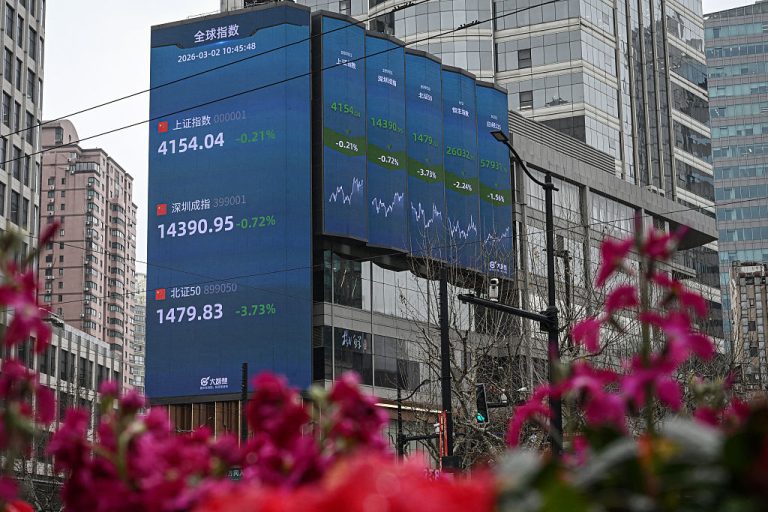
What is ‘benefiting Taiwan?’ In reality, it is the weaponization of trade
After the “Zheng–Xi meeting,” the Taiwan Affairs Office of the Chinese Communist Party announced ten “promotional exchange” policies. However, upon closer inspection, these policies are not genuine goodwill measures, but another form of political packaging.
1. Party-level arrangements disguised as cross-strait policy
The first two items are arrangements between political parties and have no direct relation to the people on both sides of the strait. In essence, cross-strait issues are fundamentally issues between two governing systems, not matters that one party can decide on behalf of a state. Moreover, no peace treaty or ceasefire agreement has ever been signed across the strait.
In 1991, then-President Lee Teng-hui announced the termination of the Period of National Mobilization for Suppression of the Communist Rebellion, no longer treating the CCP as a “rebellious group.” However, this was only a unilateral decision by the Republic of China to end a state of hostility. The CCP has never renounced the use of force for unification, and no peace or armistice treaty has ever been signed between the two sides. So what is the value of so-called “party agreements”? Such “party-to-party agreements” are fundamentally untenable.
2. Restoration of direct flights as a political tool
The resumption of direct flights appears to be a positive development, but the problem is that the previous large-scale reduction in flights was itself used by the CCP as a tool to pressure Taiwan’s government. Now it speaks of restoring normalization, yet does not acknowledge that it once used aviation links as a political weapon, thereby completely reversing responsibility.
The real question is: since it was the CCP that first applied pressure on the Tsai Ing-wen administration, why is there no acknowledgment of wrongdoing today?
3. The issue of Taiwan’s agricultural and fishery products entering the mainland is also a political tool.
Normal trade should be based on equality and mutual benefit, not on accepting political preconditions first.
The Chinese Communist Party now says it is “providing facilitation,” which actually implies that obstacles had already been set in place earlier. In essence, both creating barriers and offering facilitation reflect the same logic of control—one is hard pressure, the other is soft persuasion.
So-called “benefiting Taiwan” is not truly about benefiting Taiwan. Isn’t it just the Chinese Communist Party’s usual practice of weaponizing trade—offering “sweeteners” when others comply, and creating obstacles when they do not? If there is genuine sincerity, all that is needed is to remove barriers, not to “provide convenience.”
4. ‘Kuomintang–CCP cooperation’ is full of historical lessons
If this so-called “Zheng–Xi meeting” is viewed in a historical context, the CCP’s pattern becomes even clearer.
The first Kuomintang–CCP cooperation took place under Sun Yat-sen’s policy of “allying with Russia and admitting the Communist Party.” CCP members joined the Kuomintang as individuals, infiltrating it extensively to the point that after Chiang Kai-shek took Shanghai, he was forced to launch a purge of Communists.
Although the Kuomintang benefited from Soviet support and successfully completed the Northern Expedition, the CCP benefited even more by establishing roots among workers and peasants and developing its own armed forces, laying the foundation for later confrontation with the National Government.
The second cooperation was triggered by the Xi’an Incident, influenced by CCP-linked figures Zhang Xueliang and Yang Hucheng. The CCP gained legitimacy while retaining independent development. As Kuomintang forces were depleted in the main battlefield against Japan, the CCP expanded during the war years and even leveraged complex interactions with Japanese forces to grow stronger, gaining the capital to later compete for control of China.
After Japan’s defeat, Mao Zedong personally went to Chongqing for negotiations, buying time for the CCP. After the civil war broke out, with support from the Soviet Union and remnants of the Kwantung Army, the CCP expelled the Republic of China to Taiwan within just three years.
When the CCP is weaker or cannot overcome the other side, it uses united-front tactics. But when it holds an advantage, its “peace talks” essentially amount to unconditional surrender by the other side.
In 1949, Fu Zuoyi signed the “Agreement on the Peaceful Settlement of the Peiping Issue” with Communist forces, which in effect was an unconditional surrender document. Nationalist troops were fully reorganized into Communist forces, and many were later sent to the Korean War as expendable troops.
In 1951, Beijing and the local government of Tibet signed the “Seventeen Point Agreement for the Peaceful Liberation of Tibet,” which stipulated “high-degree autonomy” for Tibet. It stated that, except for military and foreign affairs being under central control, the positions of the Panchen Lama and the Dalai Lama as the highest religious and political leaders would remain unchanged, along with 17 guarantees.
However, within less than three years, the Chinese Communist Party began to gradually erode the special status of Tibet that it had previously promised to uphold. Starting in 1956, preparations were made to establish the “Tibet Autonomous Region,” which in practice stripped the Dalai Lama and the Panchen Lama of their leadership roles in Tibet. At the same time, mainland policies such as land reform and the “Three Great Transformations” were forcibly implemented in Tibet. These actions contradicted relevant provisions of the “Seventeen-Point Agreement.”
A more recent example is Hong Kong. The CCP once guaranteed that Hong Kong would maintain “one country, two systems” unchanged for 50 years. Yet, halfway through that period, it used various means to undermine the system and carried out large-scale suppression of Hong Kong protests. Even the “Sino-British Joint Declaration” it had signed has been dismissed by the CCP as merely a “historical document.”
5. The CCP’s true nature: United Front when weak, coercion when strong
The most typical pattern of the CCP is this: when it is weak, it speaks of united front tactics; when it is strong, it demands submission.
When it lacks strength and needs to win over the other side, it presents itself as willing to talk, cooperate, and engage in dialogue. But once it gains an advantage, these “peace negotiations” quickly turn into unilateral concessions—or even unconditional surrender.
From historical experience, the Chinese Communist Party has never been a regime capable of honoring commitments in an equal relationship. It is more like a political machine that first wraps itself in cooperation, then uses power to rewrite promises. This has been true toward Taiwan today, toward Hong Kong, toward Tibet, and in the past toward the Kuomintang, local forces, and other political actors.
Therefore, what is most worth noting in this so-called “Zheng–Xi meeting” is that it once again reminds Taiwanese society of the CCP’s United Front strategy: seemingly harmless exchanges are in fact operations with clear political objectives. Every “gesture of goodwill” it offers may contain hidden premises, conditions, and future mechanisms of control.
So the real question is not whether to engage with the CCP, but whether one can clearly recognize the purpose behind such engagement. The CCP is highly skilled at using “exchanges” as a cover for United Front work, and using “cooperation” as a means to pursue control. If the Kuomintang forgets this point, it may well repeat the mistakes of history.
The views expressed here are those of the author and do not necessarily represent the views of Vision Times.
By He Zi