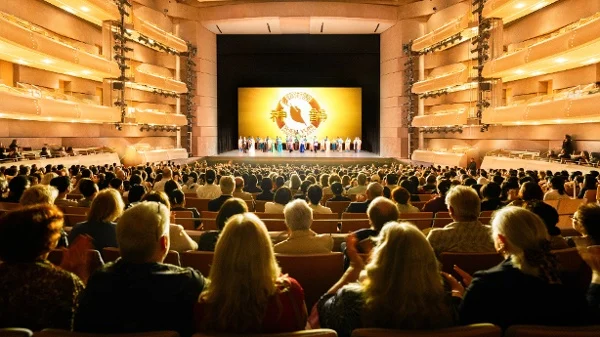
Canada’s premier performing-arts venue reversed course and rescheduled Shen Yun Performing Arts for a June run after intense public pressure, media scrutiny, and a coordinated advocacy campaign revealed that the original cancellation had been driven by anonymous bomb threats traced to a Chinese Communist Party-linked influence operation. The reversal came only after investigative journalists and human rights advocates made the operation public. The episode is a case study in how Beijing extends its domestic censorship apparatus into democratic countries, and in what it takes to push back.
How Beijing weaponized bomb threats to cancel a Toronto cultural performance
The Four Seasons Centre’s initial cancellation of Shen Yun was presented publicly as a response to security concerns. Subsequent investigations by journalists and researchers told a different story. The first threat arrived as an emailed message on March 29, 2026, sent from a Chinese Gmail account in Swedish, demanding cancellation of the Shen Yun performance and threatening Parliament Hill alongside the venue. Toronto police evacuated the audience, swept the building, and determined the threat was not credible. The venue cancelled the show anyway. Days later, citing “escalating threats,” the Four Seasons Centre cancelled the five remaining performances in the Toronto run. Nearly 10,000 ticket holders lost their seats.
The threats arrived as part of a pattern of harassment I experienced directly: dozens of confirmation emails arrived in my inbox, each purporting to confirm bomb threats sent in my name or using my email address. The tactic was designed to exploit a Western arts institution’s duty-of-care obligations and legal sensitivities as a weapon of suppression. When a foreign dictatorship can weaponize a Canadian venue’s own risk management procedures to silence a performance it dislikes, it has exercised a veto over Canadian cultural life without firing a shot.
Shen Yun Performing Arts has received over 150 false bomb threats, mass shooting threats, and threats of violence against its performers, staff, and the children of its artists over the past two years. Taiwan’s police have traced some of those threats to Xi’an, China. A phone number associated with the email account used in the Toronto threats and in a parallel campaign against Shen Yun’s Vancouver shows in April was found to be based in China. The Four Seasons Centre, according to multiple reports, became the first venue anywhere in the world to cancel multiple Shen Yun performances in response to threats that local police had determined were fake.
Shen Yun, a New York-based classical Chinese dance and music company founded in 2006 by Falun Gong practitioners, has been a target of sustained CCP pressure campaigns across Western countries for years. The Party regards the company as a vehicle for values and historical narratives it cannot tolerate: traditional Chinese civilization predating Communist rule, spiritual freedom, and testimony to the persecution of Falun Gong practitioners inside China. The bomb threats in Toronto were an extension of that campaign, adapted to Canadian legal and institutional terrain.
Success
You are now signed up for our newsletter
Success
Check your email to complete sign up
Analysts of Chinese foreign influence have described this approach as “unrestricted warfare” applied to cultural diplomacy: ambiguous, deniable coercion that stops short of physical violence but achieves the suppression that overt censorship could never accomplish in a democratic country.

Canada’s prime minister courted Beijing while a CCP pressure campaign ran in Toronto
What made the episode more troubling was the posture of Canada’s own government. Prime Minister Mark Carney traveled to Beijing in January 2026 on the first official visit by a Canadian prime minister to China since 2017. He met with Xi Jinping at the Great Hall of the People on Jan. 16 and announced a new Canada-China “strategic partnership” with five pillars covering energy, trade, public safety, multilateralism, and culture. Carney said the partnership would help “improve the multilateral system.”
The CCP is the most repressive regime on the planet, and any “multilateral system” it proposes is one built on exporting authoritarianism and eliminating the freedoms that make Canada what it is. For a head of government to extend that kind of diplomatic goodwill to Beijing, only weeks before Canadian cultural institutions were absorbing CCP pressure at home, is policy-level accommodation of the very forces attacking Canadian sovereignty.
Canada cannot simultaneously welcome the CCP as a partner in global governance and defend its institutions against CCP coercion. Every gesture of accommodation from Ottawa signals to Beijing that the costs of these operations are manageable.
Civil society, investigative journalism, and lawmakers reversed the cancellation
The reversal came through pressure from multiple directions. Five Canadian members of Parliament publicly condemned the cancellations and the intimidation campaign: Judy Sgro, a veteran MP, former immigration minister, and chair of the Parliamentary Friends of Falun Gong; Marc Dalton; Ned Kuruc; Shuv Majumdar; and Amarjeet Gill. Conservative MP Roman Baber appeared outside the Four Seasons Centre in support. Mainstream Canadian media outlets investigated the circumstances of the cancellation, keeping the story alive and building public awareness of what had actually happened. Falun Gong practitioners mounted sustained public education efforts. Shen Yun artists held a press conference in Toronto, and the company screened its documentary, Unbroken: The Untold Story of Shen Yun, at a red-carpet event accompanied by an information session for journalists and community members.
That combination of civil society pressure, investigative journalism, and direct advocacy created conditions in which continued exclusion of Shen Yun became untenable for the Four Seasons Centre. The venue’s management came to understand that capitulating to anonymous threats, once that capitulation became public, would damage the institution’s reputation far more than any genuine security incident. Toronto’s identity as a cosmopolitan, rule-of-law city was directly at stake.

The Four Seasons Centre sets a precedent for other institutions under pressure
The June return of Shen Yun to the Four Seasons Centre comes with upgraded security protocols: metal detectors, K-9 units, and uniformed police presence. The venue’s willingness to absorb that operational cost is the right response and sets a precedent worth naming explicitly. Cultural, educational, and media institutions across Canada face variants of this pressure. The Toronto case demonstrates that capitulation is not inevitable, and that standing firm, when backed by public support, carries its own institutional rewards.
The bomb-threat campaign accomplished the opposite of its intended effect. It drew far more attention to Shen Yun, to the nature of CCP transnational repression, and to the vulnerabilities of Canadian institutions than the performance itself would have generated. The regime’s attempt to suppress the company amplified exactly the message it sought to silence.
Defending Canadian sovereignty requires active choices from every institution
The CCP is extending into democratic countries the same tools of control it applies domestically: surveillance, political harassment, economic coercion, and digital threats calibrated to exploit Western legal systems. The targets extend well beyond Falun Gong practitioners or Shen Yun audiences. Uyghur diaspora communities, Hong Kong activists, Tibetan organizations, and any community whose existence or speech Beijing finds inconvenient face the same arsenal.
Canada’s legal and political architecture was built on the assumption that freedom of expression, artistic freedom, and religious freedom would be defended by the active choices of every institution and individual within the society. The Four Seasons Centre, after a period of hesitation, made the right choice. That choice should be recognized and reinforced.
Every Canadian institution that faces similar pressure confronts the same fundamental question: does it stand on the values written into the country’s foundations, or does it discover, under pressure, that those values are negotiable? Silence in the face of CCP coercion is itself a choice, and it is a choice that serves the coercer.
I received, in my own name, dozens of emails confirming bomb threats I had nothing to do with. The harassment was designed to intimidate and isolate, but it failed and the performances are going ahead. The failure of this particular operation should be understood as a signal to every other institution being targeted: the CCP’s coercive playbook depends on silence and institutional surrender. Deny those conditions, and the playbook breaks down.
Canada is a homeland for people who chose freedom, not a hunting ground for foreign authoritarian regimes. The return of Shen Yun to Toronto’s Four Seasons Centre in June is a small but concrete demonstration that the country’s foundational commitments are worth defending, and can be defended when enough people choose to act on them.
By Sheng Xue, Vision Times
(The views expressed here are the authors and do not necessarily reflect the views of Vision Times.)