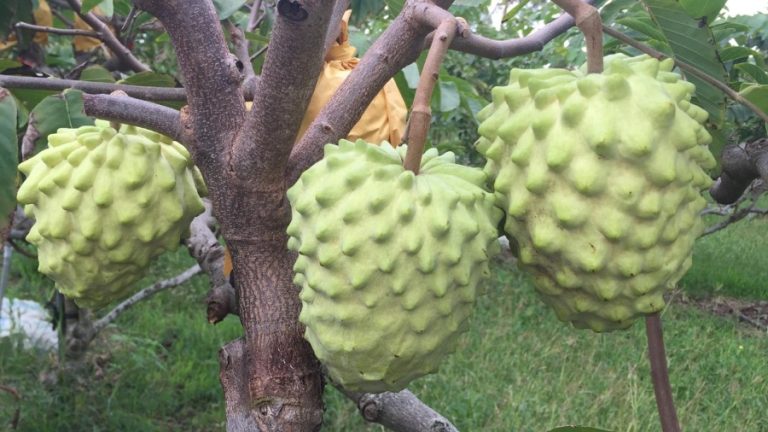
China’s import of Taiwanese Custard apples has become the latest cause of dispute across the strait after the Taipei administration warned local farmers that by increasing exports Beijing is trying to manipulate their markets and economic interests.
The controversy erupted after Yao Ching-ling, the commissioner of Taitung county in Taiwan participated in China’s Straits Forum through a pre-recorded video in an effort to secure market access for Taitung’s pineapple custard apples, reported Taipei Times.
Yao was invited to participate in the forum’s main conference held in Xiamen, in China’s Fujian Province, on Saturday last week but because Taiwan’s Mainland Affair’s council (MAC) considers the forum a “Chinese Communist Party united front platform” and the Taiwanese law forbids any individual or organization in Taiwan to cooperate with such Chinese agencies–Yao wasn’t allowed to attend the forum in person.
However, a well-known agricultural social media page in Taiwan, “Agronomy Girl Sees the World” argued that the problem is not limited to Yao’s episode but is deep rooted because of already existing years of “technical exchanges” between Taitung officials and China.
Such exchanges have already resulted in the complete transfer of pineapple custard apple cultivation technology to China. According to the page, China’s cultivation area for pineapple custard apples is now three times larger than Taiwan’s. The page called on Taiwan not to focus exclusively on the Chinese market but instead to expand into other overseas markets.
Success
You are now signed up for our newsletter
Success
Check your email to complete sign up
Farmer: the biggest problem is China’s 29% tax
Rao Ching-ling participated in the Straits Forum through a pre-recorded video, saying that she was speaking on behalf of Taitung’s pineapple custard apple growers. It erupted into a big controversy and Taiwan issued a warning to its farmers. However the farmer leaders contend that the problem is already existent and complicated because of the taxes China imposed on imports in 2024.
According to a report by the Central News Agency, Taiwan’s Mainland Affairs Council stated that it had asked the competent authority, the Ministry of the Interior, to investigate the matter of Yao’s participation in the forum.
On June 17, the Ministry of the Interior said it would examine whether the pre-recorded video constituted a form of “cooperation” under Article 33-1 of the Act Governing Relations between the People of the Taiwan Area and the Mainland Area. Further administrative investigation will proceed in accordance with communications from the Mainland Affairs Council and relevant administrative procedures.
Wang Chih-wei, chairman of a pineapple custard apple cooperative in Taitung, however told Central News Agency that all the political controversy has little effect on the fruit industry because: “Things are already miserable enough.”
He said the dispute has neither positive nor negative effects on pineapple custard apple sales. According to Wang, the biggest obstacle to exporting pineapple custard apples to China is the 29 percent tax burden, consisting of 20 percent tariff and 9 percent value-added tax (VAT).
He stressed that: “Eliminating the tariff is the most important issue.”
Wang argued that whether Rao Ching-ling personally travels to China or participates through a recorded video makes little difference.
In his view: “It only increases Rao Ching-ling’s personal visibility.”
‘Farmers should not become victims of political struggles’
Chen Ying, a legislator from the Democratic Progressive Party (DPP), stated that regarding the recent discussions surrounding the Straits Forum, her position is that farmers should not be made victims of political struggles.
She praised Rao Ching-ling for her long-standing efforts to promote agricultural development in Taitung.
According to Chen, what matters most to farmers is very simple: “That the agricultural products they work so hard to grow can be sold, can fetch good prices, and can provide stable income for their families.”
Chen added that she respects the central government’s position of administering matters according to the law.
She noted that the Straits Forum has long involved cross-strait political issues and that the central government has its own legal and policy considerations. Such discussions, she argued, should not be reduced to a conflict between local and central authorities, nor should farmers be forced onto the front lines of political disputes.
‘Technology leakage to China’: Taitung officials reap what they sow
Separately, the well-known agricultural social media page “Agronomy Girl Sees the World” published an analysis on Facebook on June 19 describing the Taitung pineapple custard apple situation as a typical case study and highlighting several key issues.
The page pointed out that China currently imposes a 29 percent tax burden on Taiwanese agricultural products. In addition, it argued that years of “technical exchanges” between Taitung officials and China resulted in the transfer of pineapple custard apple cultivation technology to Chinese producers.
According to Wang Chih-wei, who was interviewed on the matter: “At present, the cultivation area of pineapple custard apples in Guangxi exceeds 6,000 hectares, already more than twice Taiwan’s area. Yunnan has about 2,000 hectares, which is also approaching Taiwan’s total cultivation area of 2,800 hectares.”
He further stated: “Producers in Yunnan have already overcome the technical challenges of large-scale winter production, and product quality is rapidly approaching Taiwan’s standards.”
‘The consequences of excessive cross-strait agricultural dependence’
The agricultural commentary page “Agronomy Girl Sees the World” stated bluntly: “In other words, the rapid expansion of China’s pineapple custard apple industry is precisely the unintended consequence of Taitung officials’ active exchanges with China.”
The page continued: “In reality, China’s pineapple custard apple cultivation area is already three times that of Taiwan’s. Whether in terms of production volume or price, China no longer has much incentive to purchase fruit from Taiwan.”
According to the analysis, the difficulties facing Taitung agriculture cannot be solved simply by local leaders “going to plead or beg” for market access.
Instead, “the industry needs to change direction as quickly as possible and stop focusing exclusively on the path of moving westward into the Chinese market.”
Taiwan must expand beyond the Chinese market
Why is it so difficult for pineapple custard apples to be exported to countries other than China?
The analysis explained that pineapple custard apples are typically harvested while still firm and require a post-harvest ripening process before consumption.
The higher the temperature, the faster the fruit softens and ripens. Under normal conditions, shelf life is only about three to seven days.
Once the fruit becomes fully ripe, it is highly susceptible to splitting and mold.
For domestic sales, this creates pressure related to transportation distance and delivery time. For exports, limitations in storage and transportation technology restrict the fruit’s practical shipping life to approximately one to two weeks.
For destinations outside China, sea freight often results in spoilage rates ranging from 30 percent to 80 percent, making losses extremely high. As a result, exports mainly rely on air freight, which is expensive and can only handle relatively small volumes. This significantly reduces international competitiveness.
Existing technology could extend shelf life
The page noted that long-distance storage technologies do exist.
For example, by using refrigerated containers with elevated carbon dioxide concentrations, producers can suppress the fruit’s respiration and metabolic activity, extending shelf life by approximately three to four additional weeks.
However, because of the associated costs, controlled-atmosphere storage technology has not yet been widely commercialized.
Meanwhile, the Taitung District Agricultural Research and Extension Station has explored alternative approaches.
As early as 2021, it introduced a whole-fruit freezing technology that combines rapid freezing and vacuum packaging to extend storage life.
By integrating ripening technology with freezing technology into a single production process, frozen pineapple custard apples could be commercialized as an export product.
Frozen products also have the advantage of avoiding certain quarantine and phytosanitary barriers in overseas markets.
Nevertheless, whether such technology can be commercialized ultimately depends on whether buyers are willing to pay prices that justify the investment.
‘Taiwan has the technology and talent’
The analysis concluded by asking: “Taiwan clearly has the technology and the talent needed to develop overseas markets for pineapple custard apples. So why hasn’t it happened?”
Its answer was: “Taitung’s pineapple custard apples are not without opportunities. But the route into China has already been blocked by tariffs. If local leaders want to find a way forward, they cannot focus only on China. They must actively develop other markets.”
The page argued that only when market opportunities become sufficiently large will investment in transportation technology, cold-chain logistics, and food-processing technology become commercially viable.
The social media page emphasized that this process cannot be accomplished overnight.
Taking local government leaders in southern Taiwan—particularly those from southern Taiwan counties like Tainan, Kaohsiung, and Pingtung—as examples, the page noted that they spent at least three to four years participating in international trade exhibitions, actively promoting their products, organizing tasting events, and marketing them overseas.
Only after sustained efforts did foreign buyers begin to take notice. Over time, some overseas customers who initially wanted to “test the waters” gradually became regular buyers.
As a result, producers were able to slowly reduce their dependence on the Chinese market and move away from a situation in which they had no alternative export options.