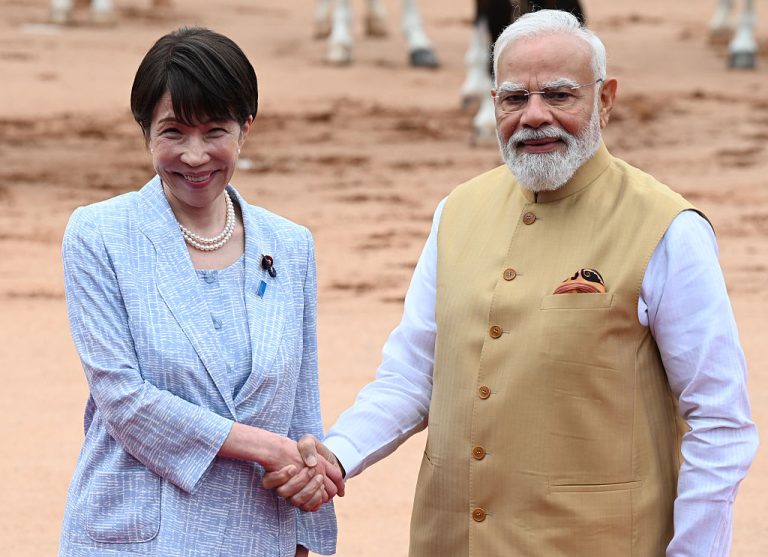
Japanese Prime Minister Sanae Takaichi paid a state visit to India from Tuesday, July 1, to Thursday, July 3, to attend the 16th India–Japan Annual Summit in New Delhi. Experts said the meeting was highly significant for bilateral ties as well as for the vision of a “Free and Open Indo-Pacific,” as it re-emphasized India’s central role in the region.
The visit saw the announcement of 129 memorandums of understanding (MoUs) and cooperation agreements between governments, companies, universities, research institutions, and industry organizations. The agreements mark an important new phase in India-Japan cooperation across economic security, defense, resilient supply chains, artificial intelligence, semiconductors, and the broader geopolitical landscape of the Indo-Pacific.
“The two Prime Ministers reiterated that as leading democracies and major economies of the world, they have a duty to shape and uphold an international order which is free, open and based on the rule of law,” said the joint statement released by Japan’s Ministry of Foreign Affairs on July 2. It added that the strategic importance of the bilateral relationship has become even greater amid today’s increasingly volatile and uncertain geopolitical environment.
RELATED COVERAGE
- Japan Arrests 3 Over Alleged Cambodia Organ Transplant Brokerage Involving Chinese Physician
- China Tests Submarine-Launched Ballistic Missile During US-Led RIMPAC Exercise
- Courting Beijing, Bangladesh Backs Xi’s ‘Community With a Shared Future’ Slogan
Vibhav Kant Upadhyay, who has worked on India-Japan ties since the launch of the India-Japan Global Partnership in 2000 and is regarded as one of the architects of the modern India-Japan partnership, told Vision Times that the two countries have spent the past two decades building trust through initiatives such as industrial corridors, high-speed rail, and manufacturing cooperation.
“This visit signaled the beginning of the next phase—co-creating critical technologies, strengthening semiconductor ecosystems, collaborating on artificial intelligence, and expanding defense-industrial cooperation,” Upadhyay said.
Success
You are now signed up for our newsletter
Success
Check your email to complete sign up
“Even more important was the shared re-establishment of the fact that India and Japan are not merely bilateral partners; together they are becoming architects of a stable Indo-Pacific.”
Takaichi and Modi also emphasized deepening economic cooperation between the two countries. Japan announced a target of 10 trillion yen (US$62 billion) in private investment for India last year, and Japan’s Ministry of Foreign Affairs said investment commitments totaling 2 trillion yen (US$12.3 billion) have already been made since that announcement.
The strengthening of economic ties was also reflected in the participation of more than 150 Japanese companies during Takaichi’s visit. Nearly 120 cooperation documents were announced alongside the summit.
“Prime Minister Takaichi stated that improving the business environment is crucial for further private investment and trade promotion, and requested India’s efforts in this regard led by Prime Minister Modi,” the ministry said.
Ret. Air Marshal Anil Khosla, a prominent Indian strategic affairs and geopolitics commentator, told Vision Times that India-Japan cooperation has evolved into a long-term strategic partnership.
“At a time when the global economy is being reshaped by geopolitical competition, trusted partnerships are becoming as important as traditional trade relationships,” he said.
Japan pushes Indo-Pacific concept
Japan has long been a pioneer of the Indo-Pacific concept, rooted in the idea of the “confluence of the seas” first articulated by the long-serving late prime minister Shinzo Abe — of whom Takaiichi is considered a protégé — in a speech before the Indian Parliament in 2007.
Abe later expanded on the concept in his 2012 essay, Asia’s Democratic Diamond, written before the start of his second term as prime minister, in which he argued for closer cooperation among regional democracies to counter China’s growing influence.
Like Abe, Takaichi also ran an article before her visit to India. In “Japan and India: Strategically Aligned Trusted Partnership,” published in The Times of India on July 1, she quoted one of Abe’s best-known remarks: “A strong India is good for Japan and a strong Japan is good for India.” Her emphasis on Abe’s vision underscored India’s central place in Japan’s Indo-Pacific strategy.
“We should view the Pacific and Indian Oceans as one and that it is our shared responsibility to pursue freedom and prosperity by cooperating with like-minded countries. This vision remains as relevant as ever, and there is a compelling need for Japan and India to cooperate in realising this goal,” she wrote.
Her renewed emphasis on India’s centrality to the Indo-Pacific comes as the United States appears to be placing less emphasis on the term in recent months. Two weeks before Takaichi’s visit, the name of the regional U.S. military command was changed from the U.S. Indo-Pacific Command (USINDOPACOM) to the U.S. Pacific Command (USPACOM) on Monday, June 16.
U.S. Secretary of Defense Pete Hegseth also made a noticeable shift in terminology during his speech at the International Institute for Strategic Studies’ Shangri-La Dialogue in Singapore on Friday, May 30, referring instead to the “Pacific” or the “Pacific region” rather than “Indo-Pacific.”
The term “Indo-Pacific” itself had gained prominence over the earlier “Asia-Pacific” in the 2000s as policymakers and analysts emphasized the growing role of India and the Indian Ocean region in geostrategic thought.
Khosla said India and Japan, as Asia’s largest democratic and major economic powers, play a key role in advancing the principles of a “free and rules-based Indo-Pacific [which] is all about preserving international law, freedom of navigation, open trade, and peaceful resolution of disputes.”
“Their cooperation would improve maritime security, strengthen disaster response, and diversify supply chains. It would result in regional stability and economic growth.”
During the 16th India–Japan Annual Summit, Prime Minister Modi and Prime Minister Takaichi oversaw the signing of 129 MoUs and cooperation agreements involving governments, companies, universities, and other organizations across sectors including technology, investment, artificial intelligence, economic security, and advanced manufacturing.
According to Khosla, Japan has long been recognized for its advanced manufacturing capabilities and high-quality standards.
“These agreements could deepen India’s integration into global supply chains,” he said.
Upadhyay said that if effectively implemented, the agreements could become one of the most consequential economic developments in the history of the India-Japan global partnership.
AI cooperation
Prime ministers Takaichi and Modi also held a small-group meeting on the morning of July 2, which resulted in the announcement of three major outcome documents, including the Japan-India Joint Declaration on Economic Security Cooperation and the Japan-India Joint Statement on Cooperation in the Field of Artificial Intelligence.
The standalone joint statement on artificial intelligence makes AI one of the central pillars of bilateral cooperation. The agreement covers the joint development of large language models (LLMs); cooperation on frontier AI safety, governance, evaluation, and cybersecurity; the development of resilient AI supply chains; and collaboration on secure AI infrastructure, including data centers, GPUs, and semiconductor computing resources.
The two countries also agreed to cooperate on AI applications for healthcare, education, public services, and industry, while expanding joint research through universities and national laboratories.
Upadhyay said the AI agreement provides India with an opportunity to transition from “being primarily a services economy” to a “major innovation and advanced manufacturing hub.”
“For the Indo-Pacific, diversified and trusted supply chains reduce systemic risks while improving long-term economic resilience,” he said.
Under the India-Japan AI partnership, Japan plans to invite 500 highly skilled Indian AI professionals by 2030. According to the Japan-India Joint Statement on Cooperation in the Field of Artificial Intelligence, released by India’s Ministry of External Affairs on Wednesday, July 2, the government-backed talent mobility initiative is intended to promote joint AI research, development, and commercialization.
According to Khosla, the partnerships in AI and advanced technology could accelerate India’s digital transformation by strengthening semiconductor and electronics manufacturing while fostering breakthrough research collaboration and creating high-skilled jobs.
“For the Indo-Pacific, it would diversify production networks. This, in turn, would make the regional supply chains more resilient to geopolitical disruptions,” said Khosla, cautioning that any impact eventually would rely less on the number of MoUs signed and depend more on their timely implementation, regulatory coordination, and sustained private-sector participation.
Co-development of Defense Projects
The cornerstone of the 16th India–Japan Annual Summit was the announcement of the first-ever India–Japan defence co-development project: the UNICORN (Unified Complex Radio Antenna) system for the Indian Navy.
UNICORN is an integrated mast that joins multiple communications and electronic systems into a single enclosed structure and its joint development by India and Japan relies on effective coordination where Japan contributes advanced design and communications technology while India undertakes system integration and manufacturing under Make in India initiative.
The Memorandum of implementation on this project was signed in 2024 but on July 2, Takaichi and Modi declared it as the first India–Japan defence co-development project.
The joint-production of UNICORN is thus being hailed as a milestone in the defence industrial cooperation between India and Japan and the beginning of a broader defence technology partnership, according to experts.
Khosla said that the agreement indicates a shift from a conventional buyer-seller relationship between India and Japan to one focused on co-development and co-production, exemplifying an enhanced strategic trust between the two partners.
“The agreement is in alignment with India’s’ Make in India’ initiative and defence policies. It will afford Japanese companies enhanced opportunities to engage in India’s growing defence industrial ecosystem,” he said.
Upadhyay said strategic coproduction between India and Japan creates opportunities to jointly develop next-generation defense technologies; reduce dependence on single-country suppliers; strengthen industrial capabilities in both countries and improve interoperability between their armed forces.
“Private industry and startups are also likely to play a much larger role, making defense cooperation a driver of innovation rather than simply procurement,” said Upadhyay.
Both experts said India-Japan defense cooperation is likely to expand over the next five years into areas including unmanned systems, maritime surveillance technologies, electronic warfare, cyber capabilities, and next-generation defense manufacturing.