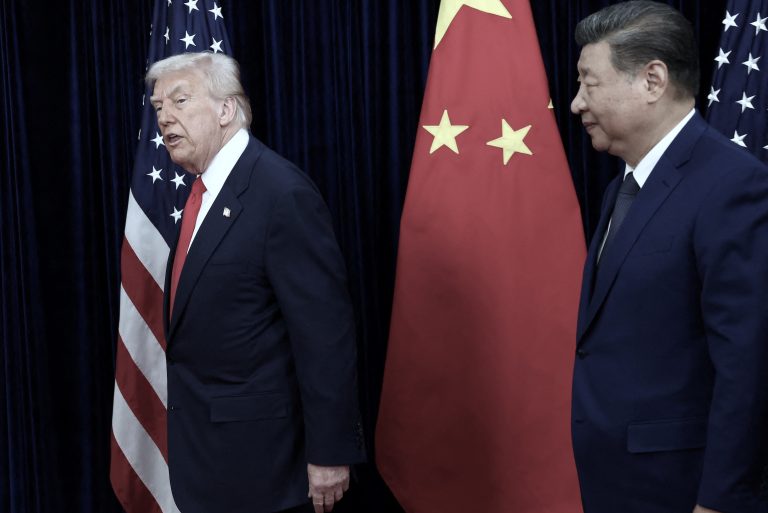
After traveling to East Asia for a round of visits including the ASEAN summit in Malaysia, U.S. President Donald Trump met with Communist China’s leader Xi Jinping at a South Korean air base on Thursday (Oct. 30).
Trump, whose meeting with Xi is the first the two leaders have had face-to-face in six years, said that he and Xi had struck a deal in which the United States would reduce tariffs on China in exchange for the People’s Republic of China (PRC) resuming purchases of American soybeans and lifting export controls on rare earths.
Beijing has also agreed to crack down on the illicit fentanyl trade, the president said, calling the meeting with Xi a “great success.”
The last time that Trump and Xi had met in person was in 2019, when the leaders of the world’s two most powerful countries spoke on the sidelines of that year’s G20 summit in Osaka, Japan.
Asia tour
The meeting with Xi took place at the Gimhae airbase in Busan, a large city at the southeastern edge of South Korea. It marked the finale of Trump’s Asia tour, on which he also touted trade breakthroughs with South Korea, Japan, and Southeast Asian nations.
Success
You are now signed up for our newsletter
Success
Check your email to complete sign up
After arriving in Malaysia on Oct. 26 to attend this year’s ASEAN summit, U.S. and Chinese officials arrived at a preliminary framework for a trade deal that would pause planned U.S. tariffs and delay China’s rare-earth export control regime.
Rare earth elements are a group of metals, often found in trace amounts, that are crucial for the production of modern electronics and military equipment. The PRC currently controls about 90 percent of the world’s rare earths production.
Trump then went to Japan, where he met with the country’s new prime minister Sanae Takaichi, a conservative nationalist who was elected to her position on Oct. 21. Trump praised Takaichi’s achievement as her country’s first female prime minister, while the U.S. and Japan signed a number of deals on trade and rare earths.
Under its outgoing prime minister Shigeru Ishiba, Japan had pledged US$550 billion in U.S. investments as part of its efforts to avoid heightened American tariffs on its products.
Arriving in South Korea on Oct. 29 to attend the Asia-Pacific Economic Cooperation (APEC) summit, Trump met with South Korean officials, including President Lee Jae-myung, to make progress on a U.S.–South Korea investment and trade deal worth around US$350 billion.
Trade understanding or temporary detente?
Following his meeting with Xi, Trump spent around 15 minutes answering questions from reporters, but did not get into many specifics of their conversation or what had been agreed to. The president then boarded Air Force One and headed back to the United States.
But with both the U.S. and China increasingly willing to play hardball over areas of economic and geopolitical competition, many questions remain about how long any trade detente may last.
The trade war reignited this month after Beijing proposed dramatically expanding curbs on exports of rare-earth minerals vital for high-tech applications, a sector China dominates.
Trump vowed to retaliate with additional 100 percent tariffs on Chinese exports, and with other steps including potential curbs on exports to China made with U.S. software — moves that could have upended the global economy.
As they sat down with their delegations to begin talks, Xi told Trump via a translator it was normal for the two leading economies of the world to have frictions now and then. “I am willing to continue working with President Trump to lay a solid foundation for China-U.S. relations,” he added.
China’s yuan currency rose to a near one-year high against the dollar as investors hoped for an easing of trade tensions that have rocked global business. World stock markets from Wall Street to Tokyo have hit record highs in recent days.
Prior to the meeting with Xi, Trump said in a Truth Social post that the U.S. would resume testing of nuclear weapons immediately, something America has not done since 1992.
His remarks, which he was asked about by a reporter in Busan but did not respond to, come after Russia announced that it had conducted a successful test of its “Poseidon” nuclear torpedo, a weapon designed to devastate entire coastlines.
Trump’s post noted the growing size of the Chinese nuclear arsenal, which has expanded to 600 warheads. The Pentagon believes Beijing will have around 1,000 nuclear bombs by the year 2030.
Reuters contributed to this report.