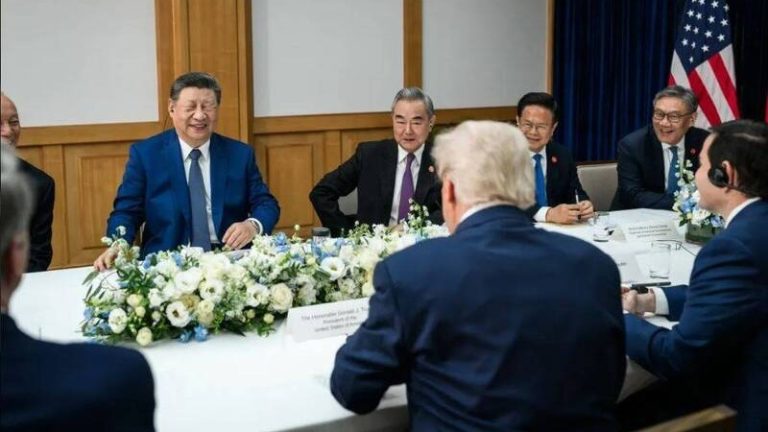
The long anticipated Trump-Xi meeting took place on Oct. 30 in Busan, South Korea. In photos released by the White House after the meeting, Chinese President Xi Jinping was seen laughing heartily. At the APEC Summit in Gyeongju, when Xi gifted two Xiaomi phones to South Korean President Yoon Suk-yeol and his spouse, he jokingly said, “You can check if there’s a backdoor.” These two incidents showed rare moments of Xi openly expressing emotion, moments which quickly went viral online. However, according to CNN, these photos are completely absent from mainland China’s internet, including social media and video platforms like Douyin and Xiaohongshu.
CNN reported that the White House photos captured a rare moment of Xi laughing openly. At that time, then-President Trump held a card up to show Xi, which made him laugh until his eyes squinted, and even Chinese Foreign Minister Wang Yi, standing nearby, laughed as well.
Additionally, during the APEC summit, Xi and Yoon exchanged symbolic gifts. When Yoon received the Xiaomi phones from Xi, he jokingly asked, “How secure is the communication?” Xi replied with a smile, “You can check for backdoors.”
Given the frequency of mobile phone eavesdropping incidents, gifting phones between heads of state is sensitive. It’s no wonder Yoon asked directly about security and even required Xi to clarify that they could check for any “backdoors.”
Xiaomi phones use screens manufactured by LG Display, but abroad, they are often suspected of having backdoor programs that could steal personal information and track phone usage.
Success
You are now signed up for our newsletter
Success
Check your email to complete sign up
The report noted that these two “spontaneous moments” are in stark contrast to the carefully cultivated image Xi maintains domestically. In China, Xi strictly limits freedom of speech and tightly controls his image and information flow, forcing commentators to analyze tiny clues—like his hair color or subtle gestures—to interpret his intentions for China’s future.
CNN emphasized that these relaxed images of Xi on the international stage do not appear on the Chinese mainland’s internet. Even on the most popular Chinese video platforms, Douyin and Xiaohongshu, there are no photos or videos of Xi casually interacting with Trump or Yoon. Only a few reports mentioned the gift exchange between Xi and Yoon. The report suggests that the images of Xi’s relaxed moments were likely deleted by online censors.
Lithuanian state cybersecurity agency report: Issues found in Xiaomi phones
According to the South China Morning Post, a Sept. 21, 2021 report by Lithuania’s state cybersecurity agency indicated that Chinese smartphone giant Xiaomi had built-in functions in its flagship phones sold in Europe that could detect and censor terms such as “Long live Taiwan independence,” “democracy movement,” or “Free Tibet.”
The report noted that Xiaomi system applications, including the default browser, could censor a list of 449 Chinese terms, and that it is still being updated.
The Lithuanian National Cybersecurity Center report also stated that some functions in Xiaomi’s 10T 5G software, previously disabled in the EU, could be remotely activated at any time. The report stressed that this issue is not only important for Lithuania but for all countries using Xiaomi devices.
Margiris Abukevicius, Deputy Minister of Lithuania’s Ministry of Defense, told reporters that their advice is to avoid buying Chinese phones and to dispose of any Chinese phones already purchased whenever feasible.
The report also noted that Xiaomi phones were sending encrypted phone usage data to a server in Singapore. It claimed that Huawei’s P40 5G phones also had security vulnerabilities, while no issues were found in phones made by another Chinese manufacturer, OnePlus.
According to the South China Morning Post, Xiaomi has not responded to Reuters’ request for comment. Huawei’s representative in the Baltic region told BNS News that Huawei phones do not send user data externally.
By Wang Jun