By Cai Siyun, Vision Times
Though Hong Kong authorities maintain that 159 people died in the Nov. 26 fire that tore through the Wang Fuk Court housing complex in the city’s Tai Po District, survivors, residents, and independent analysts are questioning that figure, warning the true death toll may be far higher — possibly even exceeding 1,500.
One survivor described devastation so complete that entire residential levels were erased in the glimpse of an eye. “Entire floors of people didn’t live or die,” he said. “They just vanished.”
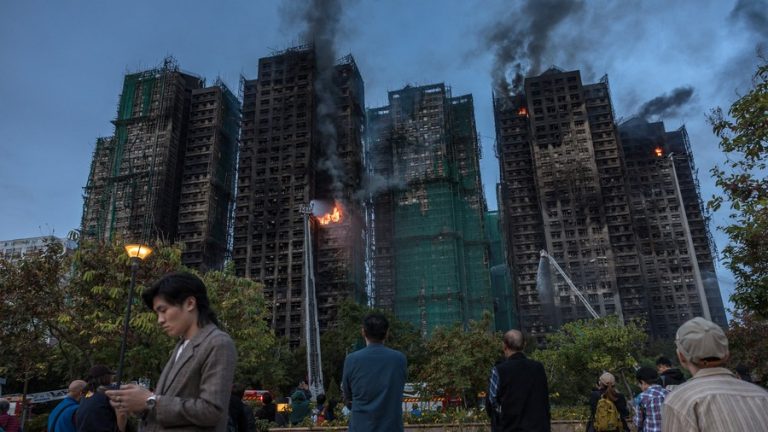
The blaze broke out on the afternoon of Nov. 26 and raced through seven residential towers within minutes. Official casualty numbers were released quickly, but many residents have questioned how a fire of such scale and speed could result in such a relatively low death toll. Survivors also described a series of compounding hazards that delayed rescue efforts, including:
- Windows sealed shut with insulation foam
- Exterior walls wrapped in highly flammable construction netting
- Fire alarms that never sounded
- Emergency exits reportedly locked
RELATED: A City in Mourning: Wang Fuk Court Fires Spark Political Crisis Ahead of Election
Success
You are now signed up for our newsletter
Success
Check your email to complete sign up
Smoke surged upward at extraordinary speed, cutting off escape routes almost immediately. Residents said those living on upper floors had virtually no chance of survival.
‘Statistically impossible’
Independent commentator Li Dayu later shared the account of a resident identified as “A,” who said the official numbers defy basic logic. Public records show that approximately 4,060 people lived in the affected buildings. Because Wang Fuk Court has a large elderly population — and the fire occurred on a weekday afternoon — many believe the number of people inside at the time was significantly higher than in other residential areas.
RELATED: Was Hong Kong’s Inferno Tied to Scandal-Plagued ‘PCR Queen’ Zhang Shanshan?
According to “A,” more than 2,600 people were inside the complex when the fire spread. If that figure is accurate, the official death toll implies a survival rate wildly inconsistent with known outcomes from comparable high-rise fires. Yet authorities listed just 31 people as missing, even as thousands of missing-person posts flooded social media in the days following the disaster.
“A” described the official death count as “statistically impossible”, arguing it serves to obscure construction failures and deflect accountability.
Scenes of total destruction
Firefighters who entered the towers later described devastation of an extreme nature. Some said bodies had been reduced to ash, while others reported encountering multiple victims on nearly every floor. Images circulating online showed charred remains scattered throughout the wreckage.
When residents were later allowed back into parts of the complex, many reported an eerie silence. Apartments that had been occupied just hours earlier were now dark, empty, and untouched.
“A” said the handling of the Wang Fuk Court fire follows a familiar pattern seen in other major disasters in mainland China. After the 2008 Wenchuan earthquake, authorities reported 70,000 deaths, while independent estimates placed the toll far higher. Writer Tan Zuoren, who documented the names of schoolchildren killed in collapsed classrooms, was later imprisoned.
He also cited the Zhengzhou floods, where officials reported 398 deaths after floodwaters filled an underpass within minutes. Thousands of submerged vehicles were later recovered, and outside observers estimated the real death toll may have reached tens of thousands.
Against that backdrop, he said the Wang Fuk Court fires figures fit the same template. “If they tell you 159,” he said, “the truth is probably at least 1,590.”
Survivor’s guilt
Among those who escaped was William Li, a lifelong Wang Fuk Court resident who has struggled to process what he witnessed. Despite his familiarity with the buildings, Li said escaping through smoke and flames was nearly impossible. He helped two elderly neighbors who were trapped with him, and the three waited more than two hours before being rescued.
Li rejects being labeled a hero. “I could have saved more,” he said, adding, “Every time someone calls me that, my heart breaks.” In an interview with journalist Chai Jing, Li revealed he had previously lived on an upper floor and had only recently moved to the second floor — a change he believes may have saved his life. None of the neighbors from his former floor have been heard from since.
For survivors like Li, the priority now is accountability. “We need more people to speak out,” he said. “It’s the only way the dead will ever receive justice.” As questions mount over construction safety, emergency preparedness, and the accuracy of official reporting, many fear that without transparency, the true scale of the Wang Fuk Court fires may never be known.
Authorities have also acknowledged that some victims may never be formally identified because their remains were charred beyond recognition, raising further concerns of the death toll’s accuracy.