By Kaiyu
More than three decades after she vanished from the screen, Joey Wong—once one of the most luminous icons of Chinese-language cinema—has resurfaced in public view, not through film premieres or interviews, but through fleeting images of an entirely different life.
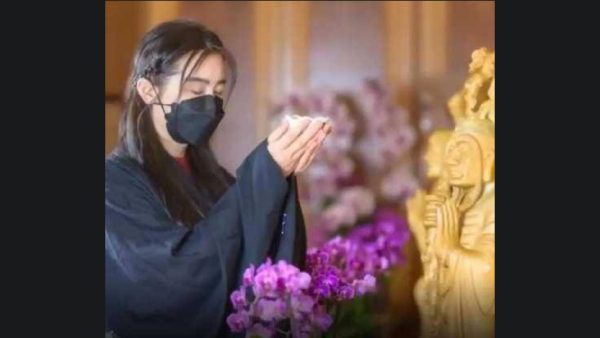
Online searches rarely yield anything beyond 2017. The most frequently circulated images show her outside a Buddhist temple in Vancouver: dressed in a gray sweater, head bowed in prayer, her profile calm and unguarded—untouched by the camera flashes that once followed her everywhere.
She once stood at the very center of the spotlight. Yet she walked away with striking decisiveness.
How did Joey Wong manage to leave the entertainment world so completely—and do so with such clarity and grace?
Success
You are now signed up for our newsletter
Success
Check your email to complete sign up
In truth, public curiosity about her life never really faded.
Acting was never her only path
Born on Jan. 31, 1967, in Taipei, Joey Wong grew up in an academic household. Her father was a professor at National Taiwan University. Unlike many performers, her childhood did not revolve around stages or cameras, but around sports.
By the age of 13, she already stood 178 centimeters tall and was a key player on her school’s basketball team. She helped lead the team to a Taipei city girls’ basketball championship. Former teammates later recalled her powerful fadeaway shots and her unflinching presence on the court. Had she continued down that path, she might well have become a figure in Taiwanese women’s basketball history.
Her entry into entertainment was almost accidental.
At 17, she accompanied a friend to audition for a shampoo commercial. A director noticed her immediately and remarked, “This girl is too beautiful.” What began as a way to earn tuition money turned into a career-defining turn.
In 1984, she caught the attention of Run Run Shaw, founder of Shaw Brothers Studio, and moved to Hong Kong to film Tonight’s the Night. At just 19, she was nominated for Best New Performer at the Hong Kong Film Awards.
What followed is well known. A Chinese Ghost Story, The East Is Red, Dream Lovers—one role after another propelled her to the peak of stardom.
Yet she never treated “actress” as a lifelong identity. She once said that acting, for her, was largely about fulfilling a director’s vision. She never chased awards or status.
Perhaps from the very beginning, fame never truly held her captive. That, in hindsight, may explain why people continue to ask why Joey Wong left.

Joey Wong loved deeply—and knew when to let go
In 1993, backstage at a concert by Taiwanese singer Chyi Chin, Joey Wong handed him a bottle of water. The two soon became a couple, and their relationship unfolded under intense public scrutiny.
Chyi Chin wrote multiple love songs for her and publicly declared that he intended to marry her. Wong, in turn, adjusted her work schedule to prioritize their time together.
Then, in 1998, a sudden revelation surfaced: the existence of a child Chyi Chin had fathered with a former partner.
Wong did not respond publicly. She offered no explanations.
Instead, she bought a one-way ticket to Canada.
A journalist who knew her later recalled that she left with just two suitcases—one filled with clothes, the other with Buddhist scriptures.
That departure marked what many would later describe as Joey Wong’s defining choice: when she left, she left completely.
READ MORE:
Stepping beyond the entertainment world
At the height of her career, Wong commanded film fees reaching tens of millions of Hong Kong dollars.
In 1991 alone, her endorsement income exceeded HK$30 million (approximately US$3.8 million)—an extraordinary sum even by today’s standards.
She was widely hailed as “the most beautiful woman in Chinese cinema.”
Yet she consistently kept her distance from the industry’s unwritten rules. She avoided cliques, declined social obligations, and often skipped award ceremonies altogether. When asked why, she answered simply: “I find it boring.”
She once remarked, “I’m afraid of facing so many people every day, without knowing who is sincere.”
By 1997, at just 30 years old and still at the height of her fame, she began deliberately reducing her workload, choosing only projects she truly wanted to make. A Chinese Ghost Story became not just a film, but a defining aesthetic memory for an entire generation.
Finding another path beyond fame
In 2001, Joey Wong formally took refuge in Buddhism at a temple in Vancouver, receiving the Dharma name Shi Huiwen.
Since then, she has lived as a vegetarian, recited sutras, released animals, printed Buddhist texts, and quietly supported schools in remote areas—never publicizing her efforts.
When photographed, she appears makeup-free, simply dressed, and at ease. She looks, by all appearances, like an ordinary person living an ordinary life.
In 2019, a Taiwanese journalist managed to reach her and asked whether she ever regretted leaving.
Her response consisted of just two sentences: “I wake up naturally every day now. I cry when I want to cry, and laugh when I want to laugh.”
“This kind of peace is something no amount of money could buy before.”
As for how she is doing now, she has long since answered that question herself.
Even at any price, she would not return
Over the years, remakes and revivals of her classic films have multiplied. Offers—some reportedly astronomical—have continued to arrive, even for brief appearances.
She has declined them all.
Now settled in Vancouver, she runs a wellness business, exercises regularly, and maintains a disciplined routine. At 58, she appears noticeably younger than her age.
She left behind an irreplaceable screen presence at the height of her beauty—and demonstrated, through a calm and deliberate farewell, another way of living.
Joey Wong passed through the entertainment world like a brief, dazzling apparition.
Then, quietly, she returned to a life that truly belonged to her.