By Fu Longshan
The Republic of China—a legitimate government that bore responsibility for the survival of the Chinese nation—how was it ultimately defeated, after the war, by a totalitarian political party willing to seize power through deception, infiltration, intimidation, and violence?
For decades, the Chinese Communist Party (CCP) has deliberately promoted a simplified official narrative: “The Kuomintang was incompetent and corrupt, therefore it lost China.” Yet as large volumes of historical documentation and firsthand testimony have gradually emerged, a truth long suppressed has become increasingly clear: the Kuomintang did not lose China on the battlefield—it lost to a systematically executed campaign of unconventional political subversion. This was not a conventional civil war, but a coordinated struggle for power that had already begun quietly during the War of Resistance against Japan.
During eight years of war, who truly bore China’s burden?
During the eight-year War of Resistance against Japan (1937–1945), the government that represented China internationally and absorbed the full cost of war domestically was the Republic of China, led by the Kuomintang. It was the Nationalist government that bore the harshest realities of total war.
Nearly all major conventional battles were fought by the National Revolutionary Army. Campaigns at Shanghai, Nanjing, Wuhan, and Changsha consumed China’s best-trained troops at devastating rates. The capital was forced to relocate to Chongqing, which then endured years of indiscriminate Japanese aerial bombardment.
Success
You are now signed up for our newsletter
Success
Check your email to complete sign up
Wartime inflation and governance collapse cannot be reduced to a crude accusation of “corruption.” To keep the war effort alive, the government was forced to issue massive amounts of fiat currency. China’s industrial base, railways, and ports were largely destroyed. Tens of millions of refugees, demobilized soldiers, and unemployed civilians had to be fed and governed. These were crushing burdens that any functioning wartime state would have been compelled to carry.

The CCP’s real wartime strategy: preparing to seize power
By contrast, the Chinese Communist Party’s central objective during the War of Resistance was never national salvation. Its patriotic slogans were largely performative, designed to deceive both the Chinese public and foreign observers. The CCP’s real focus lay elsewhere: expanding its organizational reach behind enemy lines.
In practice, the CCP emphasized infiltration, deception, and violent control of rural areas. While publicly claiming to resist Japan, it largely avoided direct engagements with Japanese forces. More damning still, Mao Zedong dispatched secret envoy Pan Hannian to conduct covert negotiations with high-ranking Japanese officials—contacts that were never acknowledged in official CCP histories.
At the same time, the CCP used the anti-Japanese war as cover to expand underground party networks and village-level organizations. These efforts were publicly framed as “rent and interest reduction,” but in reality they laid the groundwork for the bloody land reform campaigns that would follow. What CCP historiography later termed “liberated areas” were, in fact, zones of violent control established without any popular mandate.
The Yan’an Rectification Movement—often portrayed in official propaganda as a campaign of ideological education—was, according to extensive historical evidence, a systematic purge involving forced confessions, fabricated accusations, psychological coercion, and physical torture. It served as an early rehearsal for the mechanisms of totalitarian control that would later be imposed nationwide.
During the same period, the CCP carried out so-called “village cleansing” and “anti-collaborator” campaigns (1939–1945) in regions such as Central Hebei, Southern Hebei, and the Jin–Cha–Ji border areas. Individuals were arbitrarily labeled “traitors” or “landlords,” subjected to public denunciations, private torture, and execution. Violence was deliberately used to force peasants to take sides. Numerous local memoirs record death tolls from these campaigns exceeding those caused by Japanese forces in the same areas—yet such killings are absent from official wartime histories.
After the war: governance versus deliberate chaos
When the war ended, the Kuomintang faced an impossible task: restoring urban supply chains, transportation networks, diplomatic relations, and basic civil order almost overnight. The CCP pursued the opposite strategy.
Its postwar objective was to undermine governance itself—to manufacture disorder, sabotage recovery, and then shift responsibility onto the Nationalist government. The CCP deliberately spread panic over inflation, infiltrated labor unions and student movements, and incited strikes, riots, and armed clashes. It promoted slogans accusing the Kuomintang of “selling out the nation” and “oppressing the people.”
This was not romantic revolutionary idealism. It was calculated regime subversion.
Land reform: a social experiment built on terror
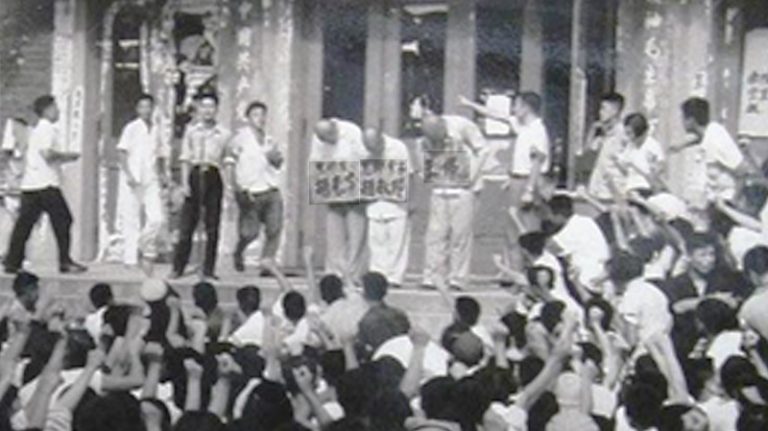
Initially promoted under the benign slogan of “rent and interest reduction,” the CCP’s postwar rural campaigns quickly evolved into large-scale, violent land reform movements (1945–1947). In North China and Manchuria, public struggle sessions forced villagers to denounce, beat, and execute landlords and rich peasants—often on the spot.
Early land reform death tolls were not counted in isolated cases, but by entire villages. This was not accidental. It was a deliberate strategy designed to create what might be called a structure of inescapable political complicity, binding participants through shared blood guilt.
Though labeled “land reform,” the campaign’s true purpose was to force the population to choose sides. Landlords were publicly humiliated and killed, while peasants were coerced into participation, ensuring they could never reverse their allegiance. China scholar Ming Chü-cheng has noted that land reform was not primarily about redistributing land, but about destroying the socially neutral class through violence. This, more than material incentives alone, enabled the CCP’s mass mobilization—combining fear, coercion, and collective culpability.
In Manchuria, during the CCP’s takeover following Japan’s surrender (1945–1946), large-scale purges also took place. After the Soviet Red Army withdrew, the CCP assumed control of former Japanese-occupied territories and executed large numbers of local elites, engineers, police officers, and non-Communist technical personnel. Executions were often conducted at night, bodies buried in unmarked mass graves. In many cities, population figures had already declined sharply before so-called “liberation.”
Similar purge killings accompanied the “liberation” of major cities (1948–1949). In and around Shijiazhuang, Shenyang, Tianjin, and Beiping (now Beijing), former government officials, police, and military family members were labeled “potential counterrevolutionaries.” They were registered, then disappeared. Nighttime gunfire became routine. There were no trials, no public records—only systematic elimination.
An asymmetric war of infiltration and psychological collapse
The Kuomintang’s retreat to Taiwan was not simply a military defeat. It was the result of infiltration, internal collapse, and organizational disintegration. The frequent breakdown of Nationalist forces during the civil war is often attributed to “low morale,” but this explanation ignores the decisive role of CCP intelligence operations: propaganda warfare, coercion of soldiers’ families, systematic inducement of defection, and terror-based intimidation.
The Kuomintang did not lose because it refused to fight. In the immediate aftermath of the anti-Japanese war, its forces were simply exhausted to the breaking point. What it ultimately lost was not a single campaign, but the struggle to defend a normal state against totalitarian subversion.
The Kuomintang paid the highest price in resisting Japan. The CCP expanded in the shadows of that war. Afterward, it seized power through violence, lies, and terror. The cost China has paid since then has been more than eighty years of totalitarian rule.
At the time, the CCP deceived a war-weary and traumatized population with soothing rhetoric—claiming to be cleaner, more idealistic, more just. Only after decades of suffering did many Chinese realize how completely they had been deceived, left with nothing but regret and tears.
What is truly baffling today is that some within the Kuomintang now present themselves as close partners of the CCP, attempting together to mislead the people of Taiwan. Is this not a form of political schizophrenia?