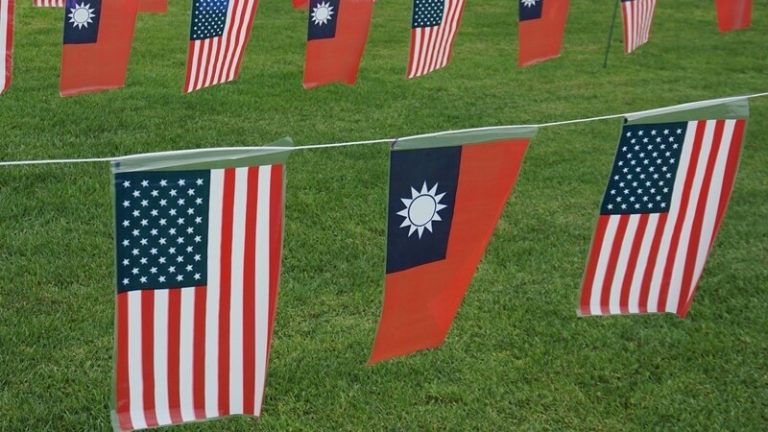
Should Taiwanese people align with the U.S. or China? If the U.S. military does not defend Taiwan, would the public be willing to resist a Communist Chinese invasion? Two recent public opinion surveys reveal the choices of the Taiwanese people.
A poll by the TVBS Poll Center shows that as many as 77 percent of respondents believe maintaining good relations with the U.S. is important for Taiwan, while 47 percent think the same about mainland China. Meanwhile, a poll by Academia Sinica indicates that more than half of respondents are willing to resist China at any cost and support purchasing U.S. military equipment.
‘Pro-US’ becomes a strong social consensus
According to a report by Today News, the TVBS Poll Center conducted surveys on “which of the three major political parties is most pro-U.S.” and “should Taiwanese people be pro-U.S. or pro-China?”
Regarding the foreign policy stances of Taiwan’s three major political parties, public perceptions are clear. TVBS Poll Center data shows:
- 82 percent of respondents see the ruling Democratic Progressive Party (DPP) as pro-U.S., while only 5 percent see them as anti-U.S.
- For the major opposition party Kuomintang (KMT), only 26 percent see them as pro-U.S., while 48 percent see them as anti-U.S.
- For the KMT’s coalition partner, the Taiwan People’s Party (TPP), 24 percent see them pro-U.S., while 42 percent see them as leaning anti-U.S.
On how Taiwan should manage relations with the U.S. and China, the TVBS poll shows that “pro-U.S.” has become a strong social consensus.

Wu Jingyi: KMT and TPP losing centrist voters
Success
You are now signed up for our newsletter
Success
Check your email to complete sign up
Political commentator Wu Jingyi wrote on Facebook on March 12 that the latest TVBS poll is like a heavy punch hitting the core of Taiwan’s political situation. Across the political spectrum, 77 percent of the public view being pro-U.S. as vital, only 13 percent oppose it, far higher than the 47 percent who value good relations with China, a 30-percentage-point gap.
This aligns with the Taiwan Public Opinion Foundation’s November 2025 survey on independence vs. unification, which found nearly 70 percent oppose unification. Together, the polls indicate mainstream opinion is breaking the “cross-strait family” narrative promoted by Beijing.
Wu criticized the KMT and TPP, saying that they mistakenly believe anti-U.S. positions energize their base. In reality, this approach not only fails to produce short-term boosts but also acts as a “poison” for future elections, accelerating the loss of centrist and young voters. Ko Wen-je’s old slogan promoting the “Cross-strait family” narrative has already lost resonance with younger generations, who see the Chinese Communist Party’s constant incursions, naval patrols, and military drills not as a demonstration of “family ties” but as practice for armed invasion.
Japanese Prime Minister Sanae Takaichi’s remark that “a problem for Taiwan equals a problem for Japan” clarified who Taiwan’s real friends are, reinforcing the Japan-Taiwan alliance and symbolizing a new “shared fate” consensus in the first island chain. If the KMT and TPP persist in blocking arms purchases and courting Communist China, they risk cementing a public perception that they are “anti-democratic, pro-China” parties.

Over half of the public willing to resist China at any cost, support US arms purchases
According to Central News Agency, Academia Sinica’s Institute of European and American Studies conducted a January survey under the “Portrait of the U.S.” project, asking: “If China attacks Taiwan, would you be willing to resist at all costs?” Two scenarios were included: “the U.S. does not defend Taiwan” and “the U.S. intervenes militarily.”
Results show:
- If the U.S. does not intervene, 58.7 percent of respondents are willing to resist at any cost (41.2 percent “very willing,” 17.5 percent “somewhat willing”), while 36.2 percent are unwilling (21.7 percent “very unwilling,” 14.5 percent “somewhat unwilling”), and 5.1 percent had no opinion.
- If the U.S. intervenes, 34.4 percent are “very willing” to resist China, 22.1 percent “somewhat willing,” totaling 56.5 percent willing to resist. Meanwhile, 34.8 percent are unwilling, and 8.7 percent had no opinion.
Pan Xin-xin, associate professor of sociology at Soochow University and one of the scholars involved, told an online press conference with the Center for Strategic and International Studies (CSIS) that both academic and government surveys show consistent trends: the vast majority of Taiwanese are willing to resist external threats and defend Taiwan.
Pan analyzed that the high willingness to resist is mainly driven by DPP supporters, while KMT and TPP supporters lower the overall percentage. Under scenarios of strategic ambiguity or clarity, DPP supporters’ willingness to defend Taiwan remains steady, but KMT and TPP supporters are highly sensitive to changes in the status quo. Without the guarantee of U.S. intervention, their willingness to resist drops.
The poll also asked whether respondents agree with increasing Taiwan’s defense budget to 3 percent of GDP. Results: 27.6 percent “strongly agree,” 25.9 percent “somewhat agree” (total 53.5 percent support); 16.9 percent “strongly disagree,” 14.2 percent “somewhat disagree” (total 31.1 percent oppose); 15.3 percent had no opinion.
Regarding arms purchases from the U.S., 69.5 percent support it (39.5 percent “strongly support,” 30.0 percent “somewhat support”), 24.7 percent oppose (13.1 percent “strongly oppose,” 11.6 percent “somewhat oppose”), and 5.8 percent had no opinion.
Pan noted that nearly all DPP supporters back U.S. arms purchases, about two-thirds of TPP supporters, and less than half of KMT supporters. This creates a stalemate on U.S. arms purchases: although the DPP actively promotes them, the combined KMT and TPP majority in the Legislative Yuan complicates implementation.
By Li Jingyao