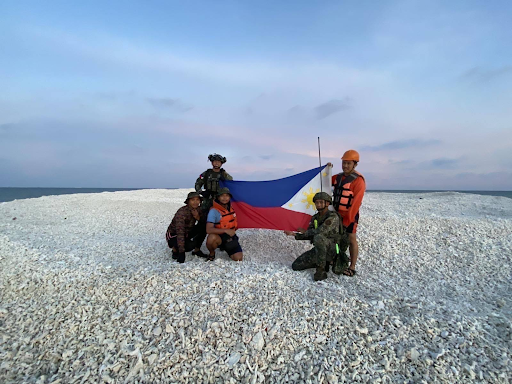
In the on-going territorial claims between Beijing and Manila, flags of both nations were raised in a disputed sandbank in the South China Sea.
On Apr. 27, members of the Philippines Coast Guard unfurled their national flag on the contested sandbank, two weeks after Chinese media reported that the Chinese Coast Guard had hoisted their own flag in the same plocation, Radio Free Asia (RFA) reported.
This also occurred right as the U.S. and the Philippines conducted the yearly “Balikatan” military drills, which saw the first usage of an anti-ship missile launcher.
Upon the raising of the Chinese flag, state-owned CCTV said that “the Philippines has made multiple attempts to send vessels near Chinese-held features in the South China Sea to monitor what it describes as artificial island-building activities.”
Jay Tarriela, spokesperson for the Philippines Coast Guard, responded on Sunday that Manila had seen the “illegal presence” of Chinese vessels and sent personnel to Sandy Cay in “four rubber boats.”
Success
You are now signed up for our newsletter
Success
Check your email to complete sign up
“This operation reflects the unwavering dedication and commitment of the Philippine government to uphold the country’s sovereignty, sovereign rights and jurisdiction in the West Philippine Sea,” Tarriela said, referring to the term used to describe the parts of the South China Sea the Philippines claims.
“We urge the People’s Republic of China and the Chinese Coast Guard to maintain the status quo in the West Philippine Sea, consistent again with the 2002 Declaration on the Conduct, which they themselves are adhered to, which they themselves continue to refer to in each and every statement issued by the Chinese Foreign Ministry,” Jonathan Malaya, assistant director general of the National Security Council, said.
Sandy Cay has been prized for its strategic location over the area around Thitu Island, where Manila could watch Chinese activity in its exclusive economic zone. This sandbank is one of several contested areas between China and the Philippines in their territorial dispute over parts of the South China Sea.
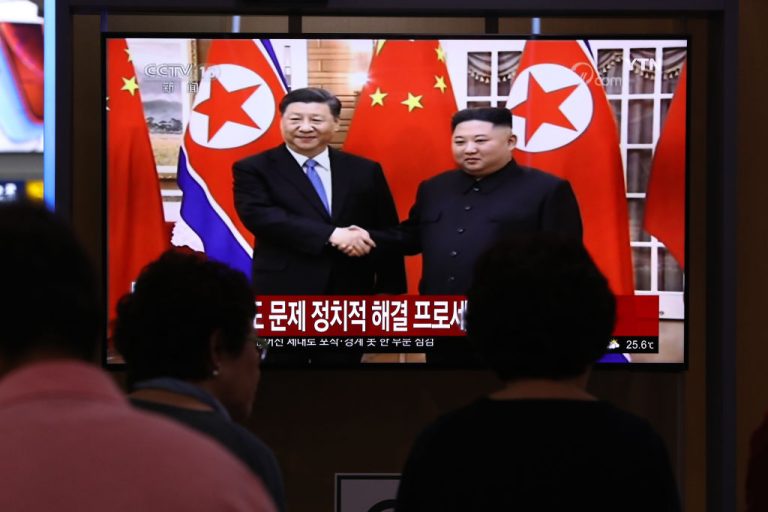
Despite international ruling over rejecting China’s claims via their “nine-dash line,” Beijing has continued to push for more military activity across the sea.
“It serves as a warning to the Philippines and other claimant states in the region that any attempt to undermine Chinese territorial integrity will be met with resolute and strong Chinese responses,” William Yang, senior analyst for Northeast Asia at the International Crisis Group, told RFA.
READ MORE:
- President Trump’s First 100 Days: A Look at the Key Actions and Impacts
- US Port Traffic Declines Sharply Following Trump’s Tariffs on China
- Japan an ‘Indispensable Partner in Deterring Communist Chinese Military Aggression’: US Defense Secretary Hegseth
Manila and Beijing heat up
Tensions between Manila and Beijing remain worrisome as both nations stake their claims.
China has blamed the worsening conditions of coral reefs around Sandy Cay on Philippine construction projects on an island close to the sandbank, South China Morning Post (SCMP) wrote.
In response to the U.S. military drills with Manila, the Chinese aircraft carrier Shandong had cruised through the Luzon Strait, north of the archipelago nation, which was considered a “show of force.”
Meanwhile in the capital of Manila itself, a Chinese national was arrested for using a surveillance device close to offices of the Philippine election commission. This came two months after two other Chinese men used the same type of device, an “IMSI catcher”, near government and military areas in the capital.
To better counter China’s potential threat, Japan had made talks of a defense pact with the Philippines, while also discussing ways to combat the economic impact of Trump’s tariffs and China’s own measures.
The missile defense systems used during the military drills were a Typhon mid-range system and the Navy-Marine Expeditionary Ship Interdiction System (NMESIS) anti-ship missile launcher, both featured for the first time in the Philippines.
“The introduction of NMESIS into the first island chain for sea denial, sea control is another step in our force design journey,” U.S. Marine Lt. Gen. Michael Cederholm told journalists.
“We’re not here practicing a war plan,” he added. “We’re practicing for the defense for the Philippines.”