In the past two years, the Chinese government has been aggressively implementing a policy of merging villages and towns affecting half of China’s 2,844 counties across 22 provinces.
This so-called “village-town consolidation,” also called “10-in-1 consolidation,” involves the government issuing administrative orders to combine several sparsely populated villages into larger villages or towns.
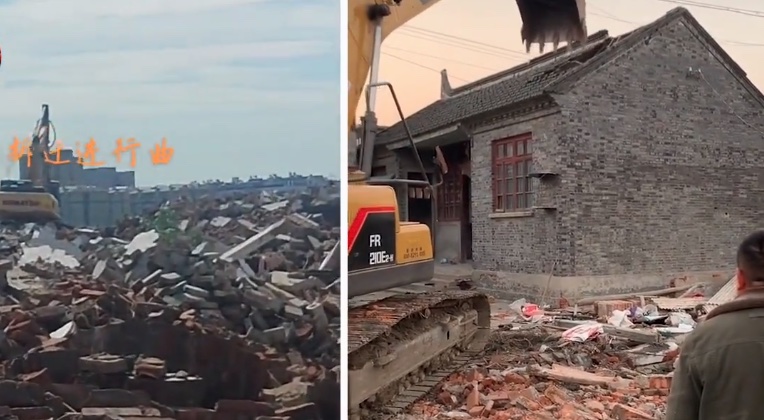
Per the scheme, villages and towns in rurals locales have their residents moved to new high-rise complexes in denser communities, while their old single-family, usually one-story homes are demolished and the land used for other purposes.
According to the Chinese Communist Party’s “Opinion on the Implementation of Supporting Poverty Alleviation in Deeply Impoverished Areas,” a policy concept that appeared in 2017, the plan is for one-third of villages across China to undergo consolidation — that is, eliminated — by 2025.
Chinese law nominally protects residents’ property (land itself is by definition owned by the government but leased to the occupants), and Beijing’s No. 1 Central Document, issued in 2024, formally outlines boundaries for the “village-town consolidation” drive.
Success
You are now signed up for our newsletter
Success
Check your email to complete sign up
But despite restrictions in the policy such as the “three prohibitions” and “two non-relocations,” people across the country have taken to social media reporting how the policy is implemented in practice.
Relocation on paper, demolition in practice
Part of the CCP’s official rationale for the village and town consolidation drive is to “revitalize” the rural economy by relocating sparse populations into denser communities. The authorities claim this will encourage business in rural areas, spur young people to move back from the big cities, and raise residents’ incomes.
- Chinese Dissidents Mark 10 Years Since ‘709 Crackdown’ on Human Rights Lawyers
- Upsurge of ‘Revenge on Society’ Attacks in China Reflects Growing Anxiety, Conflict Nationwide (November 2024)
While residents subject to village-town consolidation are supposed to be compensated with new housing, and legally have the option to keep their original property and rights, these regulations are often ignored as officials tasked with handling the consolidations simply demolish residents’ homes even without their consent or having secured replacement housing.

Many videos on Chinese social media show villagers arguing with officials and construction workers; other footage shows homes being torn down. Elderly villagers displaced by the government report having to set up shacks in their fields, while children attending rural schools shut down in the “consolidation” suddenly find themselves without education.
In the town of Sunjiazhuang, in eastern China’s Shandong Province, officials implementing the rural consolidation gave no written notice nor promises about the size or value of the new homes to be provided to the displaced locals.
Instead, the villagers of Sunjiazhuang were informed verbally that their new flats would be worth less than their current homes, prompting 200 out of 260 households to refuse the deal.

Angry at the locals’ defiance, the officials ordered the village demolished on the spot and directed police to apprehend residents who shot video of their actions.
A rural family in a village near the Shandong city of Linyi chose not to move to a high-rise, preferring to stay with their homestead. Villager Li Shang described on social media how the family found their crops dug up, utilities cut off, firecrackers set off at their doorstep, and windows broken.
- China’s ‘Internal Circulation’ Trade Policy Invites Backlash for Maximizing Exports, Restricting Imports
- ‘Living under CCP rule, anyone can become the next victim’: Statements From the Tuidang Movement (July 2025)
Under this pressure, the family gave up and their home was razed.
A similar situation unfolded in the Linyi village of Jieyuzi, where resident Wang Guanghui’s family was demolished with no compensation. His elderly parents, both over 70, now live in a makeshift shelter by a damp stream, exposed to the elements and insects.
In many videos and posts, residents and online users lamented the wanton destruction of centuries-old ancestral halls and ancient trees, flattened by bulldozers. Some have termed the razing a campaign of “village annihilation.”
“When that robotic arm knocks down a mud wall, it’s not just bricks and tiles that fall, it’s the demise of a farming civilization that’s endured for thousands of years,” one post reads.
Thinly veiled state land grab
The central Chinese government promises that the “10-in-1 consolidation” is to be carried out on a case-by-case basis, with each locale’s situation to be taken into account.
A woman called Yuan Zhen and her neighbors, residents of Yuanjiacun under the jurisdiction of Binzhou, also in Shandong, did not expect that their town — with new shops, roads, utilities, and waste collection — would fall victim to the consolidation policies.

But in the process of implementation, the community of Yuanjiacun was not spared. Homes and buildings were demolished and the villagers relocated just the same.
When officials visited Yuan Zhen, they first knocked. By the third visit, they smashed her door with bricks. Her two children cried in fear as she was forced to open the door and was taken in a van by a six-person team of officers.
In custody, Yuan’s phone was confiscated. She was interrogated for 16 hours and warned that resisting demolition would affect her children’s chances to attend university, take civil service exams, or get married.
Both local residents, like those in Sunjiazhuang, and Chinese living in other parts of the country criticized the policy as a poorly disguised land grab by the CCP and its enforcers at the grassroots.
A middle-aged rural woman in Heilongjiang Province surnamed Li posted calculations online showing how the government’s compensation per square meter offered in exchange for her home was not even half the amount needed to buy an equivalent flat in one of the “consolidated” new housing developments.
One elderly villager said, “The property management fee is 100 yuan/month, but my pension is only 180 yuan—I can’t afford it.”
On Zhihu, a Chinese question-and-answer site, a user posting under the handle “Lequ Xiaojie” gave a dreary take on the situation:
“They’re just driving farmers out of their homes to make them buy apartments and ease the government’s land finance pressure. Here in Shandong, they give 2,500 yuan/m² for a brick house. But apartment prices are 5,000. Add in renovations, and the farmers are drained.”

Another user sharply asked: “How does merging villages solve population decline? Does it magically generate people? Does it increase marriage rates or birth rates? You’re just combining the few remaining people, it’s not growth.”
Netizens harshly criticized the CCP. One wrote: “The houses themselves aren’t the most valuable thing, the land is. The government just wants to seize the land, using ‘relocation for poverty relief’ to trick farmers who don’t understand the law.”
Another said: “Land should be returned to the farmers. That’s been China’s pattern for thousands of years. In developed countries, land is privately owned. Their agriculture thrives naturally. Taiwan’s agricultural sector is booming. Unless China reforms its rural land system, there will be no real revitalization.”