
By Yang Tianzi and Leo Timm
At 8:00 p.m. local time on Feb. 8, voting in the Japanese House of Representatives snap election concluded, with exit polls and projections showing a decisive victory for Prime Minister Takaichi Sanae’s Liberal Democratic Party (LDP). The party secured well over a simple majority of seats, and together with the Japan Innovation Party (Nippon Ishin no Kai), the ruling bloc has achieved the two-thirds threshold required to revise Japan’s constitution.
This election result provided Prime Minister Takaichi with a strong electoral mandate and indicates a consolidation of political leadership around her administration, marking what some Japanese commentators describe as a new phase of Takaichi ikkyo or “Takaichi dominance” in the nation’s politics.
It also stands to reflect favorably on Takaichi herself, as she took a gamble by calling for the snap election so as to secure a public mandate for her leadership, which was originally determined by an intra-party LDP election, rather than the nation’s voters.
- Seeking Direct Public Mandate, Japan’s Prime Minister Takaichi Calls Snap Election (Jan. 20, 2026)
- US Backs Japan After Takaichi’s Taiwan Warning as Beijing Steps Up Pressure (November 2025)
- Japan Pulls Critical Chip Materials from China, Escalating Tech War
LDP secures single-party majority in rebound from recent scandals
According to exit polls released by NHK, Asahi Shimbun, Yomiuri Shimbun, and other major outlets, the LDP was projected to win between roughly 274 and 328 seats. This far exceeds the 233 seats needed for a majority in the House of Representatives, meaning the LDP could pass legislation and budgets even without coalition partners.
Success
You are now signed up for our newsletter
Success
Check your email to complete sign up
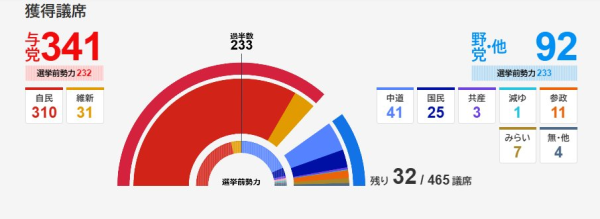
Ultimately, the LDP alone won 310 seats, while Ishin added another 31 to the ruling bloc, according to state broadcaster NHK.
In the context of Japan’s increasingly fragmented party system in recent years, such a single-party majority is relatively uncommon and indicates strong electoral support for Prime Minister Takaichi’s leadership.
For years since the 2022 assassination of influential former Prime Minister Abe Shinzo, the LDP, which has usually been Japan’s dominant party since 1955, has been mired in scnadals related to the misuse of slush funds by senior LDP figures. Takaichi’s predecessor, Ishiba Shigeru, spent only a year in office before resigning his post amidst continued political turbulence, such as a rice shortage that gripped the country last summer.
Political analysts attributed the LDP’s strong showing in the snap election to several factors. First, since taking office in October 2025, Takaichi has demonstrated decisive leadership in economic policy and foreign diplomacy. In particular, her vocal demonstration of military support for Taiwan in the event of Communist Chinese invasion caused a diplomatic row with Beijing, but helped rally Japanese around Takaichi’s administration.
Her economic agenda emphasizes structural reform and innovation-driven growth, which has helped raise voter expectations for future economic performance. In addition, the opposition parties failed to present a compelling alternative policy platform, contributing to the LDP’s electoral success.
Ruling bloc exceeds threshold for constitutional revision
Of particular significance, the LDP and the Japan Innovation Party surpassed the two-thirds threshold (310 seats) in the 465-seat House of Representatives, winning 341 of the total. Under Article 96 of the Japanese Constitution, constitutional amendments must be approved by a two-thirds majority in both houses of the Diet before being submitted to a national referendum.
Crossing this threshold in the lower house would give the Takaichi government substantial initiative in advancing constitutional revision proposals.
This election also reflects shifts in Japan’s political landscape. Traditionally, the LDP’s main coalition partner has been Komeito, a relationship that began in 1999 but fell apart last year when the smaller party left the alliance in protest over Takaichi’s right-wing nationalist views.
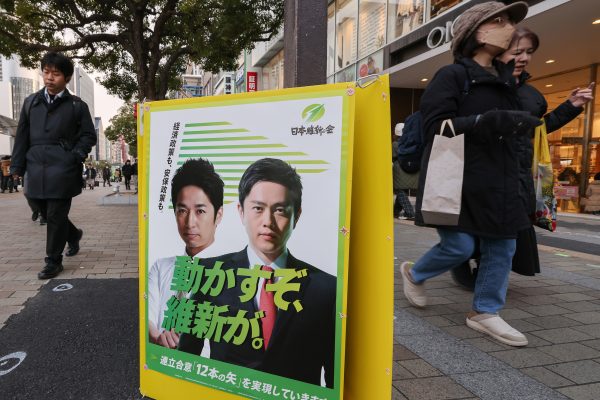
However, in this election, the former centrist coalition was replaced by cooperation between Japan’s two major right-wing parties, with Ishin’s strong electoral performance has positioned it as a key partner in governance.
Since its founding, Ishin, a libertarian-leaning party with origins in Japan’s second-largest city of Osaka, has advocated constitutional revision, decentralization, and the reduction of legislative privileges. These positions align in many respects with Prime Minister Takaichi’s policy preferences. Analysts believe that this evolving governing alignment could reshape Japan’s political trajectory over the coming years.
Emergence of a ‘Takaichi Dominance’ system?
Japanese media have described the election outcome using the term “Takaichi dominance,” echoing the earlier concept of “Abe dominance” used during the late prime minister Abe Shinzo’s long tenure (2006–2007; 2012–2020). The term refers to a political structure characterized by strong leadership and relatively weak opposition.
With a strong public mandate and clear legislative majority, the LDP-Ishin bloc will be able to advance its domestic economic and legal objective, while also presenting a more solid front in foreign policy.
- Tokyo Court Accepts Chen Guangcheng Defamation Lawsuit Against Wang Zhian
- Japan Successfully Retrieves Rare Earth Mud From Deep Seabed in Minamitori Island Mission
Prominently, the Takaichi cabinet now has more of an opportunity to pursue a longstanding goal of the Japanese right wing: revising the constitution to allow Japan’s military forces to take part in offensive operations.

But while the administration now enjoys a majority in the Japanese lower house, attempts to change the constitution would still require approval from the upper house, the House of Councillors, as well as pass a national referendum.
As the election results came in, Takaichi made brief remarks at LDP headquarters, stating that there will not be major changes in cabinet personnel during the upcoming government formation process.
Since taking office in October, her cabinet has demonstrated administrative competence, and the election effectively served as a referendum on her policy agenda. The strong result suggests voter endorsement, reducing pressure for significant personnel reshuffles.
Keeping the cabinet largely intact also enables faster policy implementation, avoiding delays caused by ministerial turnover. In political terms, the statement reflects confidence: with a decisive victory, Takaichi has greater leeway to prioritize policy effectiveness over factional balancing, strengthening her leadership autonomy within the LDP.