It’s over a year since the terrorist attack that killed 26 men at point blank range in Kashmir’s Pahalgam valley and exactly a year since India conducted “precision strikes” inside Pakistan on May 7, 2025.
Within this year so much unfolded in the region and beyond — old wars continued, new wars unfolded while disasters, floods and economic crises have kept us busy. For a journalist reporting on geopolitical affairs there’s no dull moment. Until you are on the ground reporting, witnessing the mayhem and the bloody unfolding of a war, you remain in your safe boundaries inside a newsroom interviewing people and analyzing news remotely — there are press statements, news briefings and a gamut of primary sources waiting to find space in your story.
Even this newsroom safety can’t be called an “off-war” job because in today’s context, wars are a lot about narrative — the narrative war happens inside the human mind — constantly fighting with our cognitive abilities for its version of the story. In this new scenario you can very well say that a journalist is also like a soldier if not fighting the war with guns and drones, we fight wars through discretion and analysis. It does require some cultivation of the mind to hold your ground despite intimidation, lures and coercion.
There’s a lot to learn from last year’s India-Pakistan war, but I would limit my comment to what I experienced as a journalist witnessing a far-away war closely from Taiwan where I was a visiting fellow at a university through a fellowship project of Taiwan’s Ministry of Foreign Affairs.
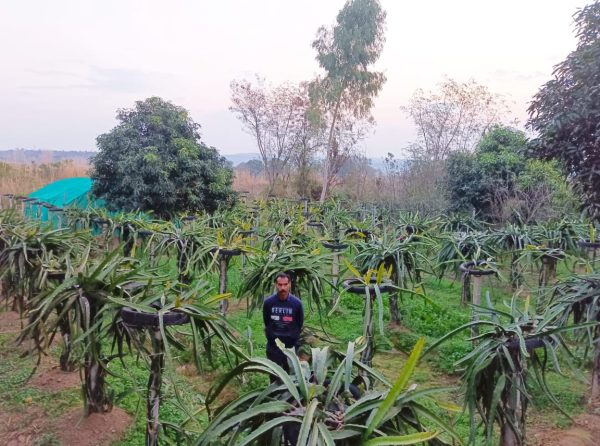
Just before leaving India for Taiwan, in February 2025, I was in Jammu, a northern city on the India-Pakistan border taking care of my ailing mother and finding time for a few journalistic endeavors travelling to witness the fresh and commendable work of cooperative societies on the same border region. I was delighted to witness a farm growing dragon fruits for the first time in Jammu. The delight was all the more because I was told that the dragon fruit saplings are a Taiwanese variety brought-in through a third country.
Success
You are now signed up for our newsletter
Success
Check your email to complete sign up
Tasting the dark pink dragon fruits sitting in the humble living room of a farmer, I never imagined that two months later, while in Taiwan, I would watch a war unfold on the same border I just visited. Life can be strangely ironic.
Waking up to news of war in a Taipei hotel
During my fellowship, I lived and worked in Taichung, a city in central Taiwan. When the Pahalgam attack happened on April 22, I was over a month into my stay and this was my first visit to the island. Taiwan Plus, the Taiwanese news show had invited me for a discussion on Pahalagam on May 7 and I had landed in Taipei a day before travelling through the very picturesque mountain railway line, something the Taiwanese are very proud of.
I had asked the hotel reception to print me a copy of the discussion brief before going to bed. I thought I was prepared, after all, I was born on the India-Pakistan border and I had several experiences of reporting from the highly militarized border both in Jammu and Kashmir–the two regions roughly separated by over 300 kilometers. In September 2024 I had spent 20 days reporting on increasing terrorist attacks in the Jammu region and had followed another story on narcoterrorism in the region.
But that hadn’t prepared me for facing the prospect of an India-Pakistan war on the borderland where I had come from. On May 7, I woke up in Taipei to an early morning message from a friend in New Delhi, “India attacked Pakistan.” A few hours later the news station texted me for a reschedule — the topic had obviously changed and we were going live much earlier.
Interestingly, the panel consisted of an Indian from Jammu, a Pakistani from a Punjabi city and a Taiwanese who appeared saddled clumsily between the two warring parties. After all, India had attacked Pakistan a few hours ago and the tension was palpable even in the newsroom.
The Taiwanese producer tried to encourage me by saying the Pakistani is a “liberal” and very polite. I won’t lie by saying that there was no tension between us and that the debate was us praising each other — we were obviously fighting on the discussion table, that is, we each had our own version of the story. That’s why we call it a narrative war, but the interesting thing is that it was all happening in Taiwan, thousands of miles from the conflict.
I remember after the debate got over, the Pakistani analyst placed with a Hong Kong think tank came over to me before hastily heading out, and said in a very Punjabi accent, “Madam, we’ll meet in Chung Hsing.” National Chung Hsing University was the institution I was placed in as a visiting fellow.
I got down the elevator with the host and the producer, and a few minutes later headed out while Taipei was characteristically raining its island weather.
Back in Taichung
I came back to Chung Hsing (中興大學) and two days later while walking back home in the campus I came across a tall Pakistani man in a Salwar Kameez (a Pakistani styled tunic and loose trousers).
He looked at me and I looked at him while we both froze as if in a moment of generations of war memories, before he abruptly and clumsily sat at a seat, as if hiding, behind a sculpture of a mother holding a child and a book in her hand. He was certainly not a student in the university and my mind was reminded of what the Pakistani analyst had told me at the news station. I never saw the analyst again while in Taiwan the whole year.
After that my mind went through a lot of confusion at witnessing South Asians on campus: are they Indians or are they Pakistanis? Some were easy to spot because their attire was visibly Pakistani, some culturally common between Indians and Pakistanis stood out as Pakistanis because of the palpable tension and hostility. After all, what can you expect immediately after a war!
In August I made a brief visit to India and made sure to land myself an assignment that would take me to the India-Pakistan border. The tensions had lived inside me and I wanted to experience reality. I choose to report from Akhnoor, a region where roughly the international border and the disputed border between India and Pakistan meet.
I visited a village in Akhnoor to gather a first hand account of residents’ experience of the war and found myself talking to those who had witnessed several wars on the same border since the creation of India and Pakistan from the post-colonial partition. To my surprise, the rural population were familiar with the various weapons used in the conflict, such as the S-400 anti-missile system.
They were not only giving me an account of the May 2025 war but a comparative analysis of how the nature of war is changing and how and why drones have turned the war into a virtual game with sky as its screen.
Cricket and open stadiums
Post Pahalgam, the India–Pakistan enmity was visible everywhere. Indians refused to play any bilateral cricket series with Pakistan and Indian players refused to shake hands with Pakistani players ahead of a cricket match. Cricket, a rugby-like game, holds a near-religious status in both nations.
This wasn’t the first time such enmity had set in, like a seasonal storm. During earlier tensions, the two countries have played matches in neutral third states, like Dubai. Third-party cricket grounds are very interesting — just like Taiwan — because they have an amazing space to engage with everyone irrespective of the status of war, and it doesn’t matter who’s diplomatically closer to China.
The Taiwanese government released a statement condemning the Pahalgam attack, following which I wrote an op-ed for Taipei Times titled, “The reason Taiwan supports New Delhi.” That is to say, I’m not implying that Taiwan supported Pakistan or that Taiwan didn’t show the moral courage to condemn a brutal terrorist attack.
What I’m saying is rather that due to Taiwan’s vague diplomatic status, instead of creating a vacuum, it provided a unique space for international engagement. For Taiwan, this doesn’t only create challenges, but also unique possibilities not available elsewhere.
And it’s not like the UK where Indian and Pakistani communities share neighborhoods. There are only 6,000 Indians in Taiwan and far fewer Pakistanis on the island, including those studying semiconductors and AI and a few running Pakistani restaurants. But what it also implies is the potential of a space for engagement just like the panel table in the newsroom on May 7 last year where I unexpectedly found myself facing a Pakistani panelist fighting with me for his version of the story of a war our nations had fought.
Taiwan is an extraordinarily open society — democratic, highly competent, constantly living under the shadow of war but having the fortune of not yet witnessing one. It thus takes a lot of interest in analyzing conflicts occurring elsewhere.
Diplomacy runs across many layers of engagement: there’s no linearity to it; it’s complex, more hidden than visible, and yet it’s always present; more mundane than creative and yet it’s always being reinvented; more docile than boastful, and yet very subversive. Call it a power game, or simply “the Game.”